 ERPLI
ERPLISquare of numbers ending in 5
Multiply the leading part by the next number, then append 25.
Worked example
75² → 7 × 8 = 56 → 5625
ERPLI Abacus includes a full Vedic Maths module with 31 tricks. Students pick a trick, practise it, and every answer is checked as they go, so your academy can offer Vedic Maths as a second course without extra worksheets.
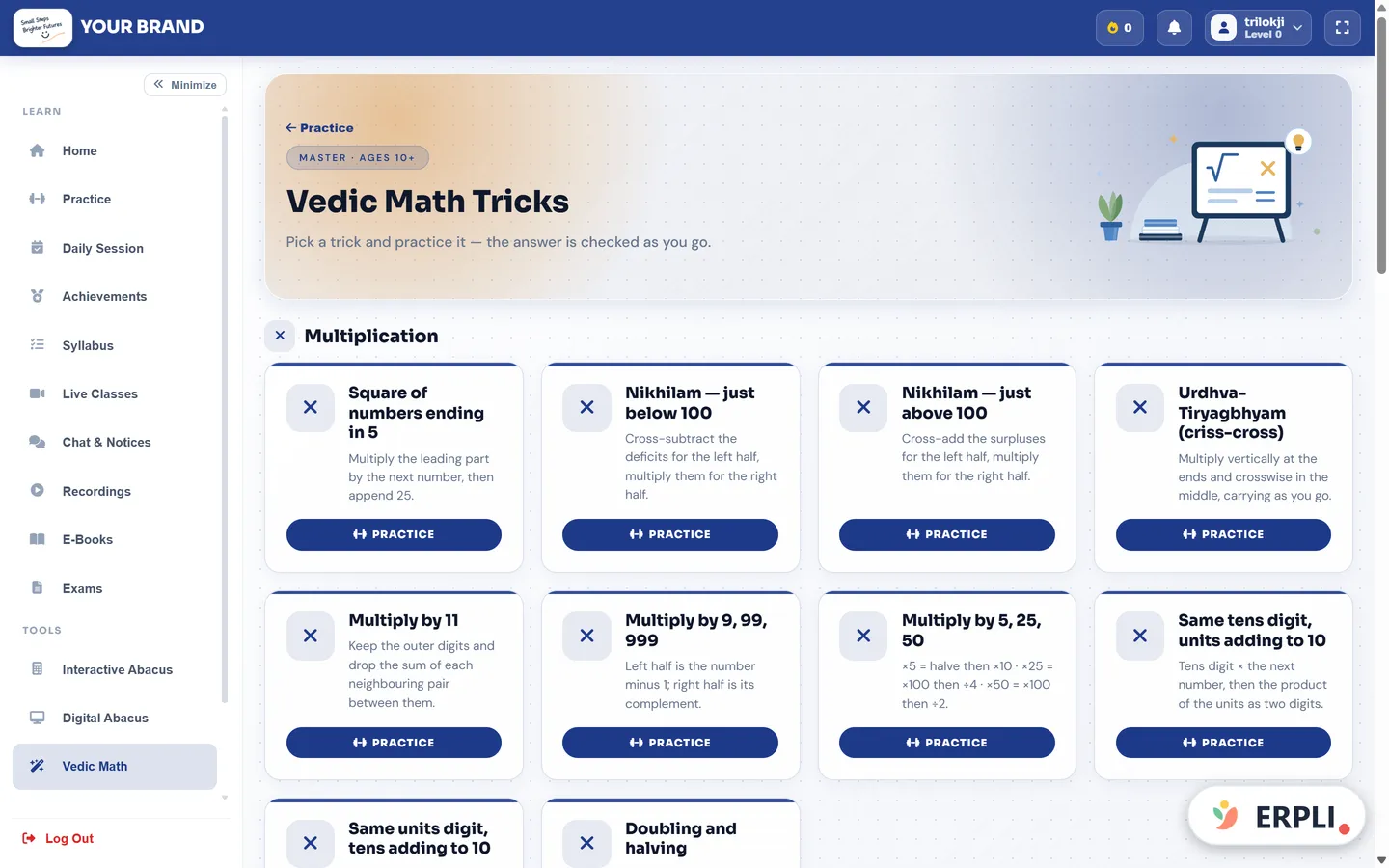
Part of ERPLI Abacus — the all-in-one software abacus academies use to teach, practise, test and run their centres.
Students get feedback on every question, so they learn the trick correctly the first time instead of repeating a mistake.
Run Vedic Maths as its own course with levels and topics. Batches and exams pick it up automatically.
Generate printable Vedic worksheets from the Question Bank in seconds, branded with your academy name.
Students see your academy logo and colours throughout the ERPLI student app.
What is Vedic Maths in ERPLI? A practice module in ERPLI Abacus with 31 tricks in six groups. Each trick has a one-line rule, a worked example, and checked answers. Vedic Maths runs as its own syllabus next to abacus.
Each trick has a one-line rule and a worked example. Tricks marked Practice have an interactive practice mode in the student panel.
Vedic Maths sits alongside the rest of the course: practise daily in the daily practice session, play the abacus games, build your course with the syllabus builder, and print worksheets from assignments.
Shortcuts that turn long multiplication into a few quick steps.
Multiply the leading part by the next number, then append 25.
75² → 7 × 8 = 56 → 5625
Cross-subtract the deficits for the left part, and multiply the deficits for the right part.
96 × 92 → 96 − 8 = 88, 4 × 8 = 32 → 8832
Cross-add the surpluses for the left part, and multiply the surpluses for the right part.
104 × 107 → 104 + 7 = 111, 4 × 7 = 28 → 11128
Multiply vertically at the ends and crosswise in the middle, carrying as you go.
23 × 12 → 2 · 1 = 2 | 2 · 2 + 3 · 1 = 7 | 3 · 2 = 6 → 276
Keep the outer digits and place the sum of each neighbouring pair between them, carrying where needed.
345 × 11 → 3 | 3+4=7 | 4+5=9 | 5 → 3795
The left part is the number minus 1; the right part is its complement to 10, 100 or 1000.
7 × 9 → 6 | 3 = 63 · 37 × 99 → 36 | 63 = 3663
× 5 = halve, then × 10 · × 25 = × 100, then ÷ 4 · × 50 = × 100, then ÷ 2.
36 × 25 → 3600 ÷ 4 = 900
Multiply the tens digit by the next number, then write the product of the units as two digits.
34 × 36 → 3 × 4 = 12, 4 × 6 = 24 → 1224
Multiply the tens digits, add the units digit, then write the units squared as two digits.
37 × 77 → 3 × 7 + 7 = 28, 7² = 49 → 2849
Halve one factor and double the other until one becomes easy.
16 × 25 → 8 × 50 → 4 × 100 = 400
Square and cube numbers near a round base in a single pass.
Add the deviation to 25 for the left part; square the deviation for the right part.
48² → 25 − 2 = 23, 2² = 04 → 2304
Apply the deviation a second time for the left part, and square it for the right part.
96² → 96 − 4 = 92, 4² = 16 → 9216
Build the answer from duplexes: a single digit’s duplex is its square, and a pair’s duplex is twice their product.
Left: number + twice the deviation · Middle: 3 × deviation² · Right: deviation³ (borrow if negative).
103³ → 109 | 27 | 27 = 1,092,727
a² − b² = (a + b)(a − b).
53² − 47² = 100 × 6 = 600
Divide quickly using complements and simple multiplications.
For divisors just below a base, bring the digits down and add the complement repeatedly.
For divisors just above a base, use the negative complement and add down.
Flag all but the first digit of the divisor, divide by the first digit, and subtract the cross products.
÷ 5 = × 2, then ÷ 10 · ÷ 25 = × 4, then ÷ 100 · ÷ 125 = × 8, then ÷ 1000.
740 ÷ 5 → 740 × 2 = 1480 ÷ 10 = 148
Add and subtract by working from the big place values first.
Subtract every digit from 9 and the last digit from 10.
1000 − 357 → 9−3 = 6, 9−5 = 4, 10−7 = 3 → 643
Add the highest place values first and adjust as you go.
Write digits 6 to 9 as bar digits (−4 to −1) and carry 1 to the next place, which shortens long additions.
Round to the nearest ten or hundred, then take back the difference.
98 + 37 → 100 + 37 − 2 = 135
Cross-multiply for the numerator, and multiply the denominators for the denominator.
1/2 + 2/3 → (1 · 3 + 2 · 2) / (2 · 3) = 7/6
Find roots of perfect squares and cubes from their last digits.
Group the digits in threes. The last digit of the root comes from the last digit of the cube, and the first digit comes from the left group.
185 193 → 57
Pair the digits from the right. The last digit of the square tells you the last digit of the root, and the leftmost pair gives the first digit.
2025 → 45
Iterative duplex subtraction gives roots of non-perfect squares to any precision.
Verify answers and spot patterns in seconds.
Reduce every number to its digit sum and check that the same operation still holds.
478 → 4 + 7 + 8 = 19 → 1 + 9 = 10 → 1
Test divisibility by 7, 13, 19, 29 and more: multiply the last digit by the multiplier (5 for 7, 4 for 13, 2 for 19, 3 for 29), add it to the rest, and repeat.
49 → 4 + 9 × 5 = 49, divisible by 7
For 1/19 use multiplier 2 and build the 18-digit cycle from right to left.
1/19 = 0.052631578947368421… (18-digit cycle)
x% of y equals y% of x. Pick whichever is easier.
25% of 80 = 80% of 25 = 20
The tricks are the standard Vedic Maths methods, popularised by the book Vedic Mathematics by Bharati Krishna Tirthaji (first published 1965). ERPLI presents each rule as a short statement with one worked example, so students can check the method with their own numbers.
Questions about a specific trick? Message the ERPLI team.
Real screens from the ERPLI Abacus admin and student panels.
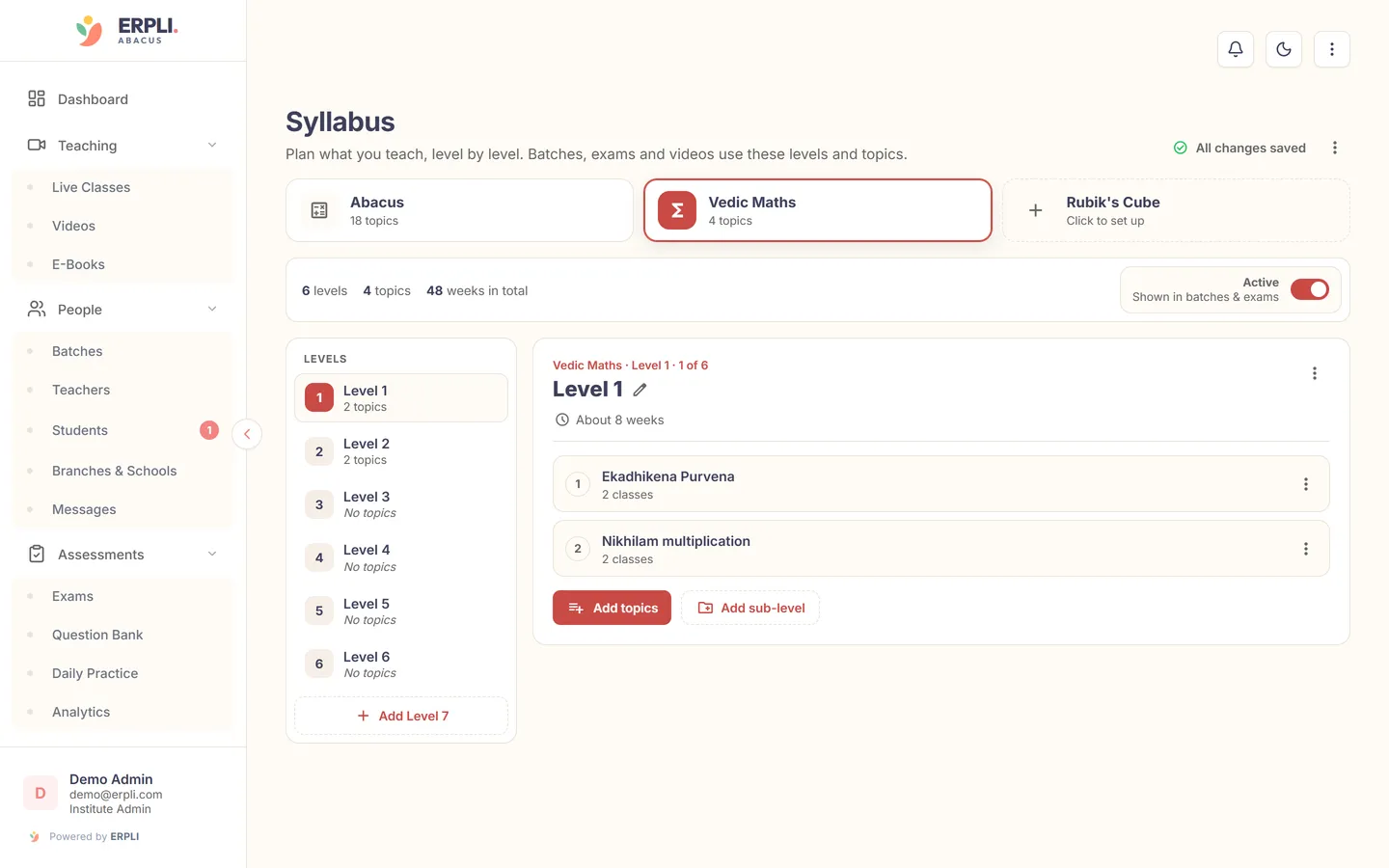
Yes. ERPLI Abacus keeps Abacus and Vedic Maths as separate syllabi in one account, so the same students, teachers and batches can use both.
ERPLI covers 31 tricks in six groups: multiplication, squares and cubes, division, addition and subtraction, roots, and checks and shortcuts. Examples include Nikhilam, Urdhva-Tiryagbhyam, squares ending in 5, multiply by 11, and osculation divisibility.
No. Vedic Maths practice in ERPLI is mental and on-screen; for abacus work students can also use the ERPLI digital abacus.
ERPLI Abacus is abacus academy software from ERPLI. It puts live classes, daily practice, games, online exams, certificates, attendance, fees and franchise management in one platform, under your academy's own brand. Vedic Maths is built into ERPLI Abacus and shares data with every other feature, so students, parents, teachers and owners all use the same login.
Built forschoolscoaching institutesprivate tutorsSee all ERPLI Abacus featuresERPLI Abacus pricingDaily practice sessionAbacus games