ERPLI

If you want to choose between abacus vs vedic maths for your academy, the right answer is usually to teach both, but at different stages. Abacus teaches calculation through bead representations; Vedic Maths courses teach selected arithmetic strategies. Choose by existing skills and teaching goals rather than a fixed age rule. Here’s a practical comparison, including age groups, teaching methods, and learning outcomes—plus advice on how to offer both for maximum impact.
Key takeaways
- Abacus is best for foundational maths and mental calculation in primary grades.
- Vedic Maths builds on arithmetic skills and suits older children preparing for exams.
- Both offer calculation practice using different techniques; individual outcomes vary.
- An academy can introduce additional arithmetic strategies once students understand the underlying operations.
- Offering both can attract a wider range of students and parents.
- See Vedic Maths for your academy for curriculum details and integration tips.

Abacus vs Vedic Maths: Quick Comparison Table
Here is a summary of the main differences between abacus and vedic maths.
| Factor | Abacus | Vedic Maths |
|---|---|---|
| Age Group | 5–12 years (primary school) | 10+ years (upper primary, secondary) |
| Method | Hands-on beads, then mental imagery | Mental calculation using 16 sutras (formulas) |
| Outcomes | Bead-based arithmetic and visualisation practice | Fast calculation, shortcut techniques |
| Suitable For | Beginners, foundational maths | Advanced learners, exam preparation |
| Progression | Level-based, stepwise learning | Modular, topic-based |
| Typical Duration | 2–3 years (levels) | 6 months–2 years (modules) |
How Abacus Works in Indian Academies
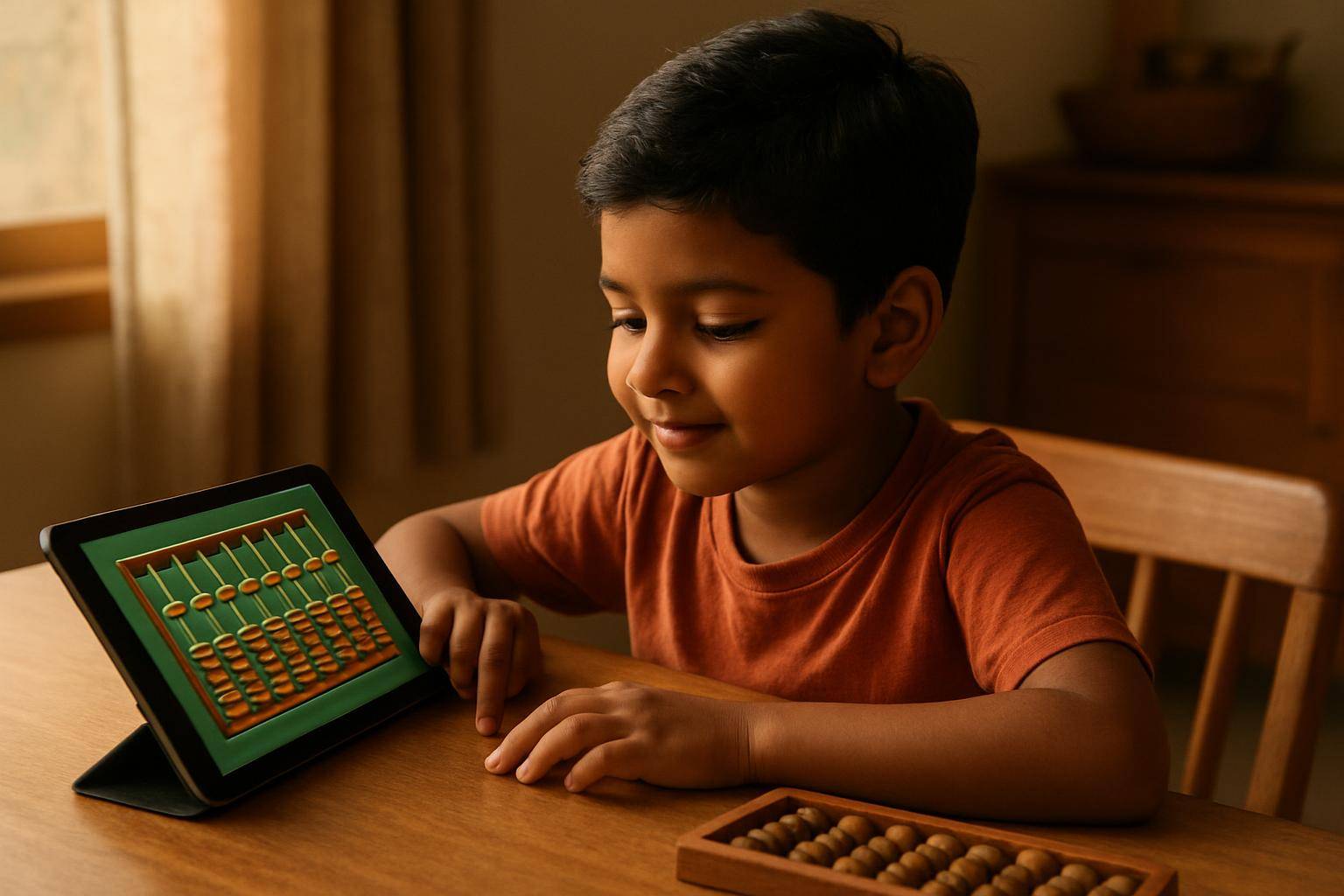
- Abacus uses a physical or digital tool with beads to teach arithmetic.
- Children start by moving beads for addition, subtraction, multiplication, and division.
- With practice, they visualise the abacus in their mind ("mental abacus"), leading to rapid calculation without tools.
- Focus is on accuracy, speed, concentration, and building confidence in maths.
- Most abacus courses run for 2–3 years, split into levels with regular practice and exams.
- Check your actual syllabus: a national education policy does not prescribe a particular commercial abacus course.
- Digital abacus tools like ERPLI Abacus LMS make it easy to manage batches, practice and exams.
What is Vedic Maths and Who is it For?
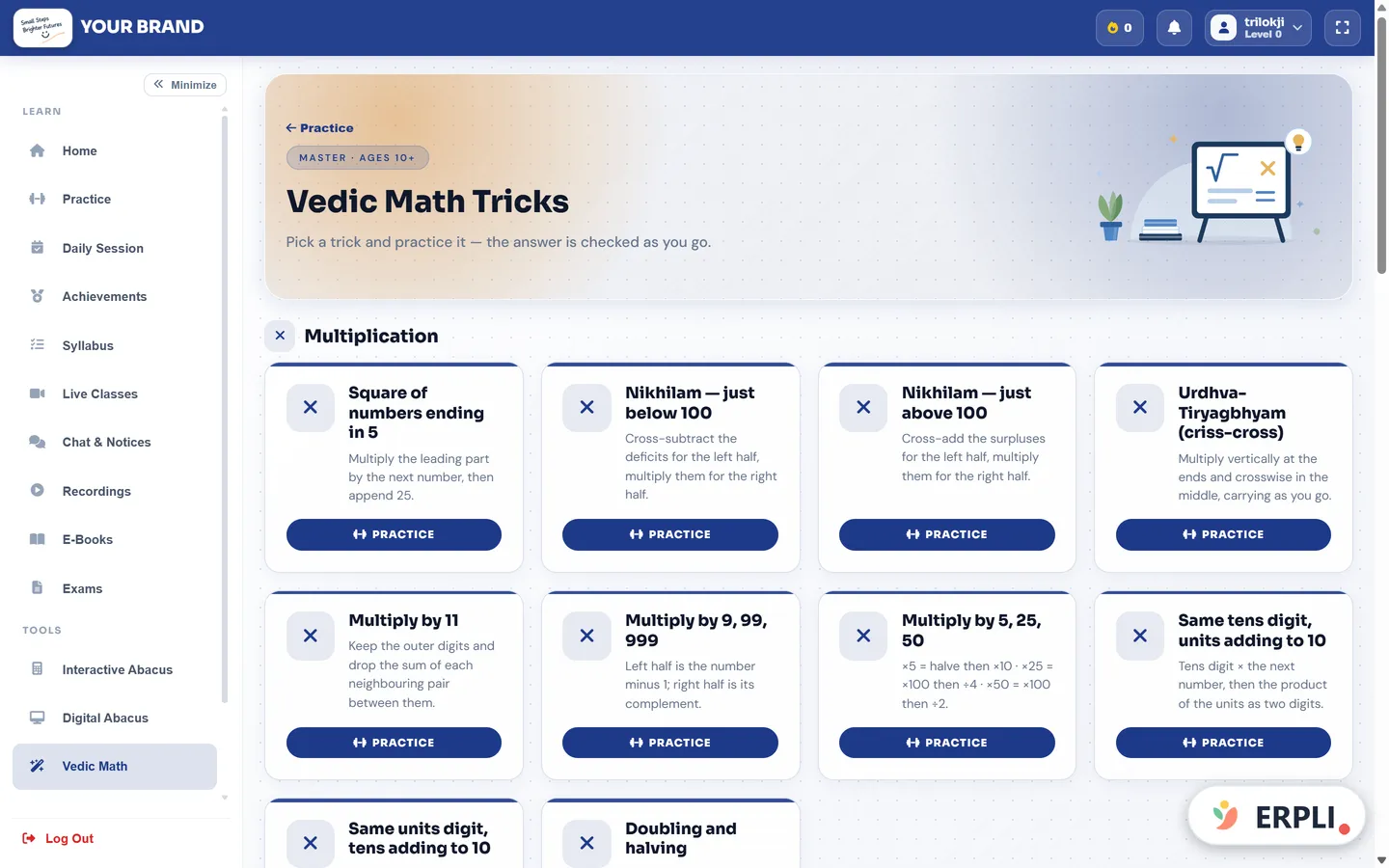
- Vedic Maths courses group calculation techniques under named sutras. Evaluate the arithmetic explanation and applicability of each technique rather than relying on historical claims.
- It uses 16 sutras (formulas) and 13 sub-sutras to solve arithmetic, algebra, and even some geometry problems quickly.
- Popular among students from class 5 upwards, especially those preparing for school arithmetic and applicable entrance-exam questions.
- Focuses on shortcuts for multiplication, division, squares, cubes, and more.
- Typically taught as a 6-month to 2-year course, depending on depth.
- Helps older students tackle complex problems and boost calculation speed for competitive exams.
Which is Better: Abacus or Vedic Maths?
- The answer to "which is better abacus or vedic maths" depends on student age and learning goals.
- Abacus offers a concrete way to practise place value and arithmetic, but teaching quality and student readiness matter.
- Vedic Maths is better for older students who already know basic arithmetic and want to solve problems faster.
- An academy can offer both when it has qualified teachers and a clear progression between courses.
- Check whether students can apply the skills to unfamiliar school problems as well as rehearsed exercises.
How to Structure Your Academy’s Curriculum
- Begin with abacus for children aged 5–8, progressing through beginner and intermediate levels.
- Introduce advanced abacus or mental maths for ages 8–12.
- Start Vedic Maths as an add-on for students aged 10+, once they are confident with basic operations.
- Organise batches by age and skill; use a digital system for tracking progress (ERPLI student management).
- Offer demo classes to parents to explain the difference between abacus and vedic maths.
Integrating Abacus and Vedic Maths in Your Academy
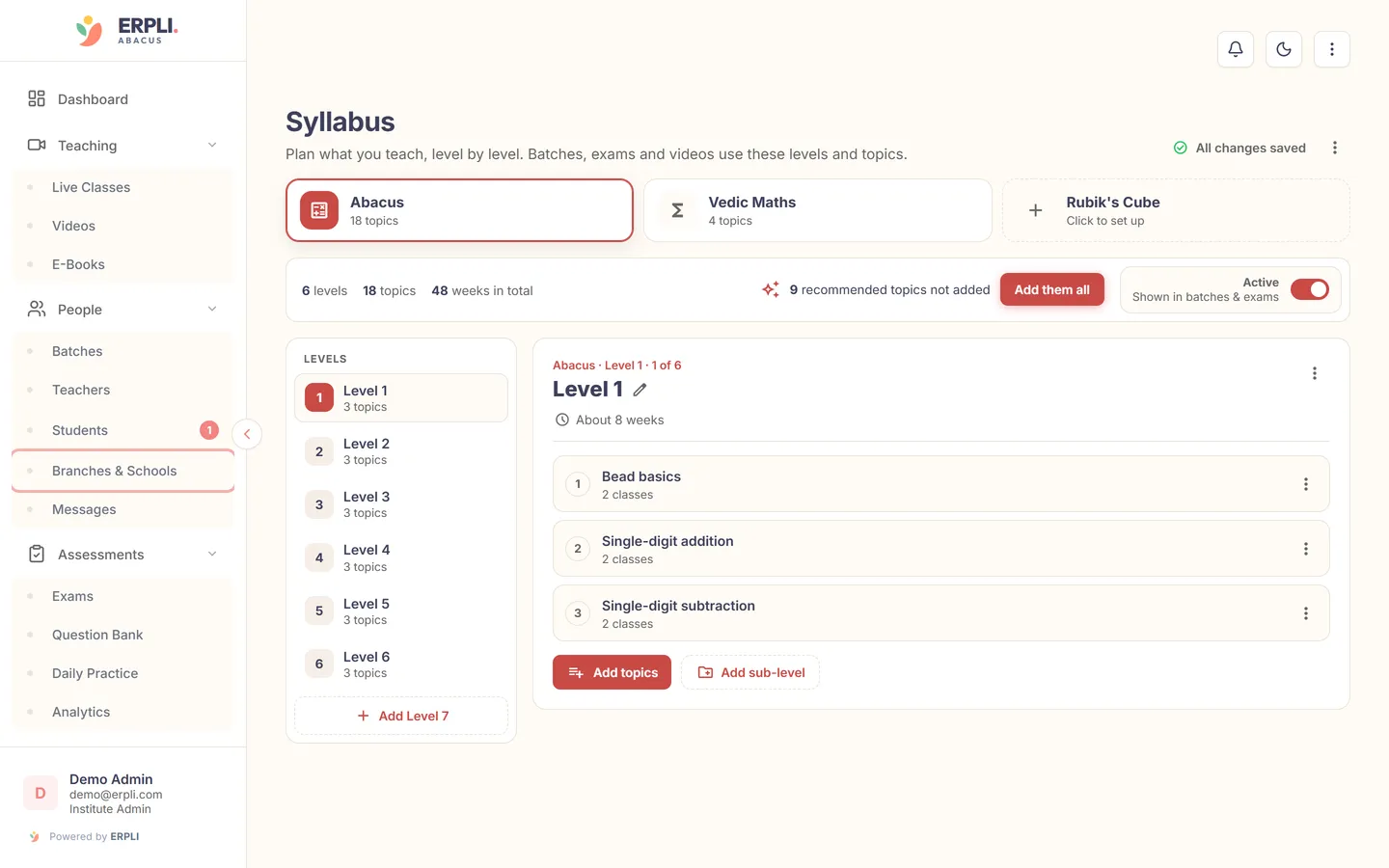
- Use blended learning: physical classes, digital practice, and online modules.
- ERPLI allows you to assign both abacus and Vedic Maths practice sets, track student progress, and schedule exams.
- You can set up level-wise curriculum and unlock Vedic Maths only after certain abacus levels are completed.
- Provide certificates for both streams to motivate students.
- Promote your academy as a "complete maths skill centre" to attract more students.
Typical Fee Structure and Business Impact
- Ask local providers for written course quotes; compare tuition, materials and assessment fees on the same basis.
- Offering both can increase your average revenue per student and improve retention.
- ERPLI Abacus LMS costs ₹50 per student per month up to 30 students, with lower rates for higher numbers. This covers both abacus and Vedic Maths management.
- No extra cost for adding Vedic Maths modules in ERPLI.
- Use analytics to see which batches perform better and adjust your marketing.
- For more details on setup, see abacus academy setup.
Next step
If your goal is to deliver complete maths skills and stand out from other academies, offer both abacus and Vedic Maths—starting with abacus and adding Vedic Maths as students progress. To manage both easily and track student progress, try a free ERPLI demo.
What we found when we searched Reddit
We searched Reddit while reviewing this article on 9 November 2026. In a discussion about the usefulness of Vedic Maths, participants questioned whether fast calculation should be confused with understanding mathematics. These are personal opinions, not a representative survey or a controlled comparison. The useful question for a parent is concrete: can the child explain why a procedure works and recognise when it applies?
For an academy comparing abacus vs Vedic Maths, that question belongs in the demo lesson. Let a child solve one familiar calculation, then change the numbers or wording. Ask for an explanation rather than another speed record. A student may be quick at a rehearsed exercise but need help deciding which operation a word problem requires. That observation should guide the next lesson rather than trigger an additional course sale.
A lesson example that makes the difference visible
Use 98 × 97 with a student who already understands multiplication. One approach is 98 × (100 − 3), giving 9,800 − 294 = 9,506. Another is (100 − 2)(100 − 3), giving 10,000 − 500 + 6 = 9,506. Both are explained by the distributive property. Ask the learner to describe the subtraction and then try 88 × 97. If a shortcut is taught without its conditions, the learner can apply it incorrectly to the changed problem.
With an abacus beginner, choose a much simpler addition and ask the learner to show the starting number, each bead change and the final value. Compare the representation with a written sum. These are different lessons with different prerequisites. Comparing abacus vs Vedic Maths by the largest number shown on an advertisement tells parents little about either lesson's quality.
What research can and cannot settle
A three-year randomised classroom study found an arithmetic advantage for mental-abacus pupils, but did not find a general change in basic cognitive abilities. It did not compare abacus with Vedic Maths. Use that evidence for the specific intervention studied, without promising that either course raises every child's intelligence or guarantees exam results.
A practical four-week academy pilot
Before offering a new stream to every batch, run a small pilot. In week one, record a short untimed baseline and note which operations pupils understand. In week two, teach one method and ask each child to explain a worked example. In week three, mix familiar and unfamiliar questions so students must select a method. In week four, repeat a comparable assessment and review errors with parents.
Keep the time spent practising similar across groups. Record absences, help received and whether the child used beads, paper or mental calculation. Otherwise, a difference in scores could simply reflect extra practice. Treat this as a teaching review, not a scientific experiment or proof that one commercial course is superior.
Use student progress records to keep observations alongside results. In the parent meeting, show one corrected error and one successful explanation. That gives a family a clearer reason to continue than a certificate alone. When choosing abacus vs Vedic Maths, start with the learner's next achievable skill and review the decision after real lessons.