ERPLI

Adding abacus for coaching institutes can quickly boost revenue, attract younger students, and build a future feeder for your main courses. If you have spare classroom space and want a low-cost, high-demand new vertical for coaching, abacus training is a proven option. Most institutes can start with minimal investment and scale as demand grows.
Key takeaways
- Abacus classes need just 1–2 hours per batch, 2–3 times a week.
- Typical revenue per abacus student: ₹800–₹1,500/month (varies by city).
- One teacher can handle 10–20 students per batch.
- Abacus attracts 6–12 year olds, building a future pipeline for your higher classes.
- Software like ERPLI automates student management, fees, and practice.
- Explore detailed setup steps at abacus for coaching institutes.

How much revenue can abacus add for coaching institutes?
- Most coaching centres charge ₹800–₹1,500 per month per abacus student (city dependent).
- Typical batch size: 10–20 students, 2–3 batches per week.
- For 30 students at ₹1,000/month: ₹30,000 monthly gross revenue.
- Deduct part-time teacher salary (₹5,000–₹10,000/month) and materials (₹200–₹300/student for basic abacus kit, one-time).
- With ERPLI, software costs are ₹50 per student per month for up to 30 students, decreasing with scale.
| Students | Fee (₹/month) | Gross Revenue | Teacher Cost | ERPLI Cost | Net (Approx.) |
|---|---|---|---|---|---|
| 15 | 1,200 | 18,000 | 6,000 | 750 | 11,250 |
| 30 | 1,000 | 30,000 | 8,000 | 1,500 | 20,500 |
| 50 | 900 | 45,000 | 10,000 | 2,250 | 32,750 |
- Additional costs: abacus kits (one-time), worksheets, small marketing spend.
- Revenue and cost vary by city and teacher experience.
Space and staff required for abacus classes
- Abacus for coaching institutes requires minimal additional space: a classroom with tables and chairs for 10–20 students.
- Sessions are typically 1–2 hours, 2–3 times a week, outside main class timings.
- Can use existing staff if they are trained, or hire a part-time abacus teacher.
- One teacher can manage up to 20 students per batch for beginners; advanced levels may need more attention.
- Minimal setup: abacus tools, printed worksheets or e-books, and software for scheduling and attendance.
- Many institutes use ERPLI to automate batch scheduling, attendance, and fee collection.
How abacus brings in younger students and builds a feeder pipeline
- Abacus attracts students from age 6–12, a segment usually not covered by typical coaching centre courses.
- These students (and parents) often stay for 3–4 years if they like your teaching and environment.
- After abacus, many families continue with your main courses (maths, science, Olympiad, coding, etc.).
- Early rapport with parents gives you a marketing edge for higher classes later.
- Abacus also appeals to parents focused on foundational maths and cognitive skills, as explained in this overview.
- Many coaching brands use abacus as a “starter track” to build loyalty and cross-sell other offerings.
What curriculum, materials and exams do you need?
- Standard abacus curriculum covers 8–10 levels, based on the Japanese soroban model (learn more).
- Each level typically takes 4–6 months to complete, with regular assessments and certificates.
- Materials needed:
- Physical abacus (one per student, ₹200–₹400 each)
- Level-wise worksheets, e-books or printouts
- Practice exercises (digital or paper)
- Occasional competitions or exams
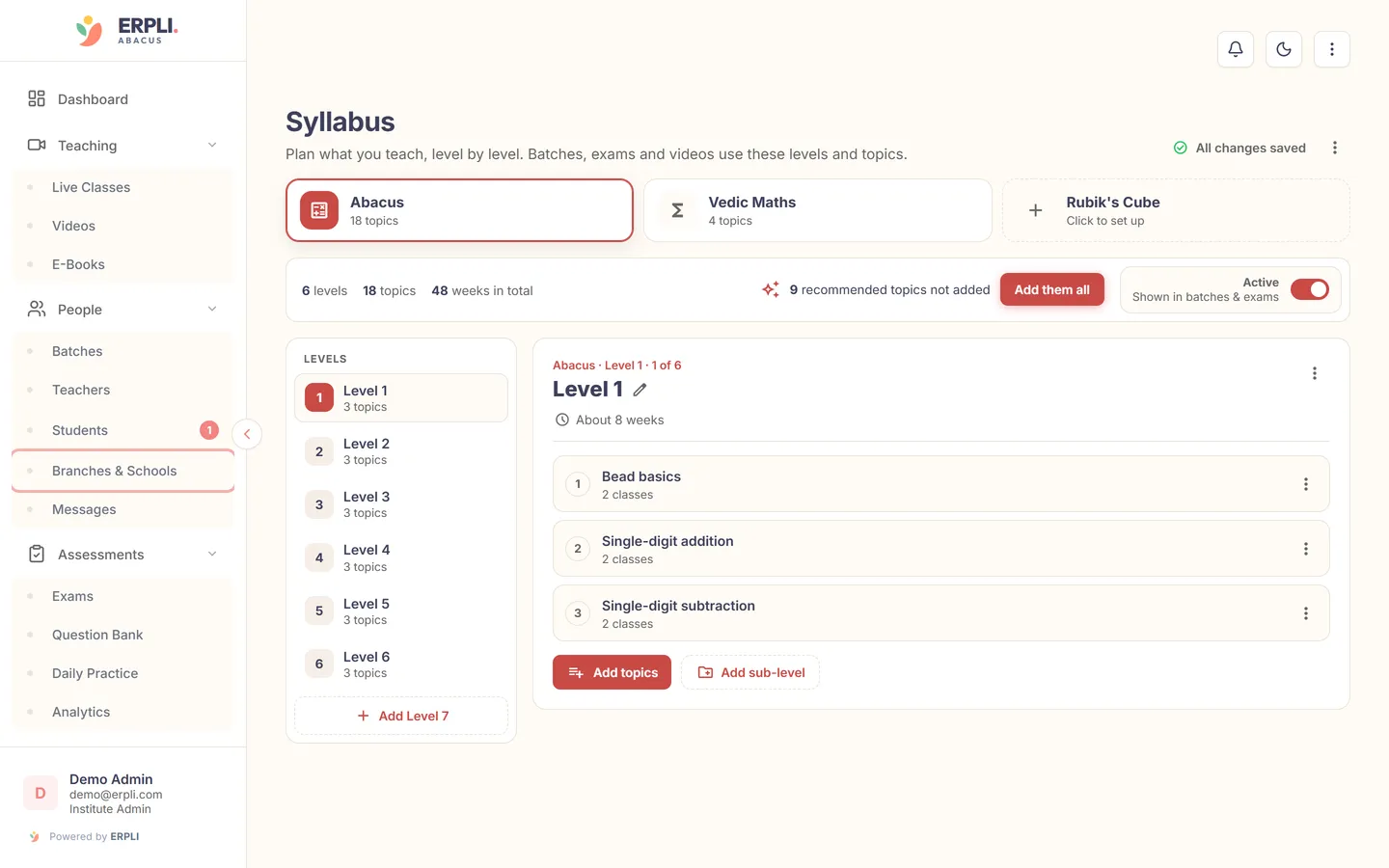
- ERPLI provides a complete digital curriculum, practice modules, and auto-generated certificates (see syllabus details).
| Level | Typical Duration | Key Skills Focused |
|---|---|---|
| Level 1 | 4 months | Counting, basic sums |
| Level 2 | 4 months | Addition, subtraction |
| Level 3 | 5 months | Multiplication basics |
| Level 4+ | 5–6 months each | Advanced/mental maths |
How to set up an abacus department: steps and timeline
1. Assess demand in your area
- Survey parents in your locality or current student base.
- Check local competitors’ fees and offerings.
2. Train or hire an abacus teacher
- Send existing staff for 2–4 week training, or hire experienced part-timers.
3. Set up classroom and materials
- Allocate 1 classroom; order abacus kits and print worksheets.
4. Launch with a pilot batch
- Start with 10–15 students; collect feedback and adjust timings.
5. Use software to manage operations
- Automate admissions, batch scheduling, attendance, and fee reminders with a tool like ERPLI (see features).
6. Promote through parent groups and schools
- Conduct free demo classes, distribute flyers, and use WhatsApp groups for promotion.
How software like ERPLI simplifies abacus management
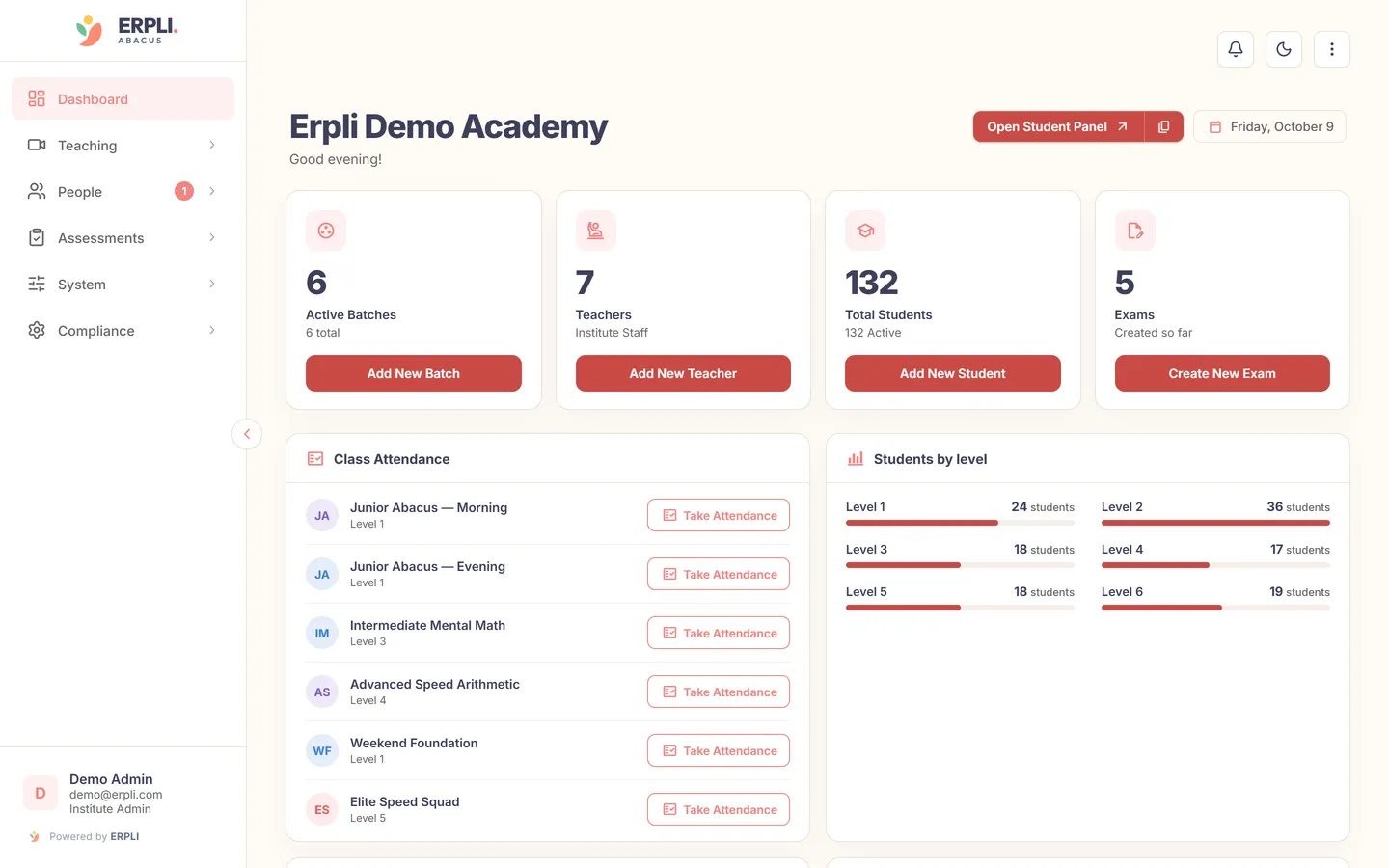
- ERPLI handles student admissions, batch scheduling, attendance, fees, and certificates in one platform.
- Includes a full digital syllabus, e-books, and unlimited practice modules for students.
- Supports live and recorded lessons, making it easy to offer hybrid classes.
- Generates detailed analytics, progress reports, and certificates automatically.
- Pricing starts at ₹50 per student per month, with costs reducing as you scale (see pricing).
- Custom branding and website included for your coaching centre.
- No franchise fees required—build your own abacus brand or add to your existing one.
Common challenges and how to overcome them
- Finding trained abacus teachers: Upskill your own staff or partner with local trainers.
- Parent awareness: Run demo classes or workshops to explain abacus benefits.
- Classroom scheduling: Use off-peak hours or weekends for abacus batches.
- Student retention: Offer certificates, competitions, and clear level progression to keep children engaged.
- Managing multiple batches: Use software like ERPLI to easily track batches, attendance, and student progress.
- Material management: Opt for digital worksheets and e-books to reduce printing and logistics.
Next step
Adding abacus for coaching institutes is a practical way to expand your student base and revenue with minimal risk. Start small, automate your admin, and build a new pipeline of loyal families.