ERPLI

Short answer: Abacus class fees in India typically range from ₹700–₹2,500 per month, depending on the city, academy reputation, and student level. Most academies charge higher fees in metros and for advanced levels, while small-town and home tutors offer more affordable options. Understanding the right fee structure helps you stay competitive and profitable.
Typical abacus class fees by city and level
The table below shows average monthly abacus class fees for group classes (1–2 hours/week), based on city type and level. Actual fees vary by locality and facilities.
| City Type | Beginner Level (Level 1–2) | Intermediate (Level 3–5) | Advanced (Level 6+) |
|---|---|---|---|
| Metro (Delhi, Mumbai, Bengaluru, Chennai, Hyderabad, Kolkata) | ₹1,500 – ₹2,500 | ₹1,800 – ₹2,800 | ₹2,000 – ₹3,200 |
| Tier-2 City (Pune, Lucknow, Coimbatore, etc.) | ₹1,000 – ₹1,800 | ₹1,200 – ₹2,000 | ₹1,400 – ₹2,400 |
| Small Town / Rural | ₹700 – ₹1,200 | ₹900 – ₹1,400 | ₹1,100 – ₹1,800 |

- One-to-one sessions may cost 30–50% more than group classes.
- Franchise academies often charge at the higher end, while home tutors are usually at the lower end.
- Fees for online-only classes are sometimes 10–20% cheaper.
Home tutor vs academy vs franchise: fee comparison
The city table shows branded-academy rates. Most women teaching from home charge less, and that is why parents choose them. Here is how the three compare for a beginner group batch:
| Who teaches | Metro (₹/month) | Tier-2 (₹/month) | Small town (₹/month) | Who keeps the fee |
|---|---|---|---|---|
| Home tutor (own brand) | 800 – 1,500 | 600 – 1,200 | 500 – 900 | Tutor keeps 100% |
| Independent academy | 1,200 – 2,200 | 900 – 1,600 | 700 – 1,200 | Owner keeps 100% |
| Franchise centre | 1,800 – 3,000 | 1,200 – 2,200 | 900 – 1,500 | 15–20% goes to the franchise as royalty |
A franchise centre charges the most and keeps the least. A home tutor on her own brand can charge 20–30% less than the franchise down the road and still take home more per student. See how to build your own abacus brand without a franchise fee.
Full course cost: what parents pay from Level 1 to the last level
Parents often ask "how much for the whole course?" Have the answer ready.
- Most courses run 8 to 10 levels, about 3 to 4 months per level, so 2.5 to 3 years in total.
- At ₹1,000/month, the full course costs a family roughly ₹30,000 – ₹36,000, plus kit and exam fees.
- Kit fee: ₹500 – ₹1,500 for the abacus, bag and Level 1 book. Charge it once at joining.
- Book fee per level: ₹200 – ₹500.
- Level exam and certificate: ₹200 – ₹600 per level, or free if you include it in the monthly fee.
Show parents the per-level price, not only the total. "₹3,000 a level" is easier to say yes to than "₹36,000".
Understanding abacus fee structure: monthly, quarterly, and packages
- Most academies offer monthly, quarterly, or half-yearly fee options.
- Quarterly packages often include a 5–10% discount over monthly payments.
- Some academies add registration (₹300–₹1,000) and material fees (₹500–₹1,500) in the first month.
- Abacus fee structure should be clearly communicated to parents to avoid confusion.
Example fee structure
Monthly: ₹1,500
Quarterly: ₹4,200 (₹1,400/month)
Half-yearly: ₹7,800 (₹1,300/month)
Home tutors may offer flexible pay-per-session models, especially in small towns.
For digital classes, consider including access to online practice modules and exams (see ERPLI Abacus LMS features).
Work out your own fee in 3 steps
Don't copy the academy next door. Work your number out from what you want to earn.
- Pick your monthly target. Example: ₹25,000 take-home.
- Add your monthly costs. Books and kits (about ₹40/student/month), ERPLI at ₹50/student/month, electricity and internet ₹1,000. For 30 students that is roughly ₹1,200 + ₹1,500 + ₹1,000 = ₹3,700.
- Divide by your students. (₹25,000 + ₹3,700) ÷ 30 students = ₹957 → round to ₹1,000/month.
If the number comes out above your local market, add students before you raise the fee. A fourth batch on Saturday morning often does more than a fee increase.
What affects abacus class fees the most?
- Location: Rent, demand, and spending power are highest in metros.
- Academy type: Branded/franchise academies charge more due to reputation and facilities.
- Batch size: Smaller batch = higher fees per student.
- Level: Higher levels require more experienced teachers and longer sessions.
- Mode: Offline classes often cost more than online.
- Extra services: Homework help, exam prep, or digital access justify higher abacus classes price.
- Some academies offer bundled packages with Vedic Maths or mental calculation (learn about mental abacus).
- Parents may pay extra for certificates, competitions, or personalised progress reports.
How to set and raise your abacus class fees
- Survey local competitors—sample 5–10 nearby academies and tutors.
- Start at a competitive rate for your area and experience.
- Offer introductory discounts for new batches or referrals.
- Raise fees gradually (5–10% per year), with advance notice to parents.
- Highlight improved facilities, digital practice, or certifications when increasing fees.
- Use software like ERPLI to track fee payments, automate reminders, and manage batches (see how to collect fees online).
How to tell parents about a fee increase
Give at least one month's notice, raise by 5–10%, and say what is new. A short WhatsApp message works better than a printed notice:
Dear parents, from 1 April the monthly fee for Level 3 and above will be ₹1,100 (currently ₹1,000). This year children also get daily online practice, level exams on the app and a certificate after every level. Children who pay the quarterly fee before 31 March keep the current rate until June. Thank you for your support.
- Increase fees at the start of a level or a new academic year, not in the middle.
- Keep current students on the old rate for one quarter. New students pay the new rate straight away.
- Never increase fees and the kit price in the same month.
What parents compare before they pay
When a parent calls three tutors, this is what they ask about. Have each answer ready:
- Fee per month and the total per level, without hidden charges.
- Batch size: 8–12 children sounds personal, 25 does not.
- Practice at home: does the child get worksheets or an app to practise daily?
- Progress: will the parent see attendance and results without asking?
- Certificates and competitions: a certificate after every level, with your academy's name on it.
- Demo class: a free first class removes most doubts.
ERPLI covers the practice, progress and certificate questions for you: children get unlimited abacus practice, parents see attendance and progress in the app, and every level ends with an exam and a certificate carrying your logo.
Managing abacus fee collection and discounts
- Common payment modes: cash, UPI, bank transfer, online wallets.
- Digital fee collection reduces manual work and errors.
- Offer sibling or group discounts (5–15%) to attract families.
- ERPLI Abacus LMS supports fee collection, receipts, reminder SMS/WhatsApp, and batch-wise reporting.
- Keep a clear record of all discounts, arrears, and concessions for transparency.
How fees work on ERPLI
ERPLI is software, not a franchise. You set your own fees and keep 100% of them, with no royalty.
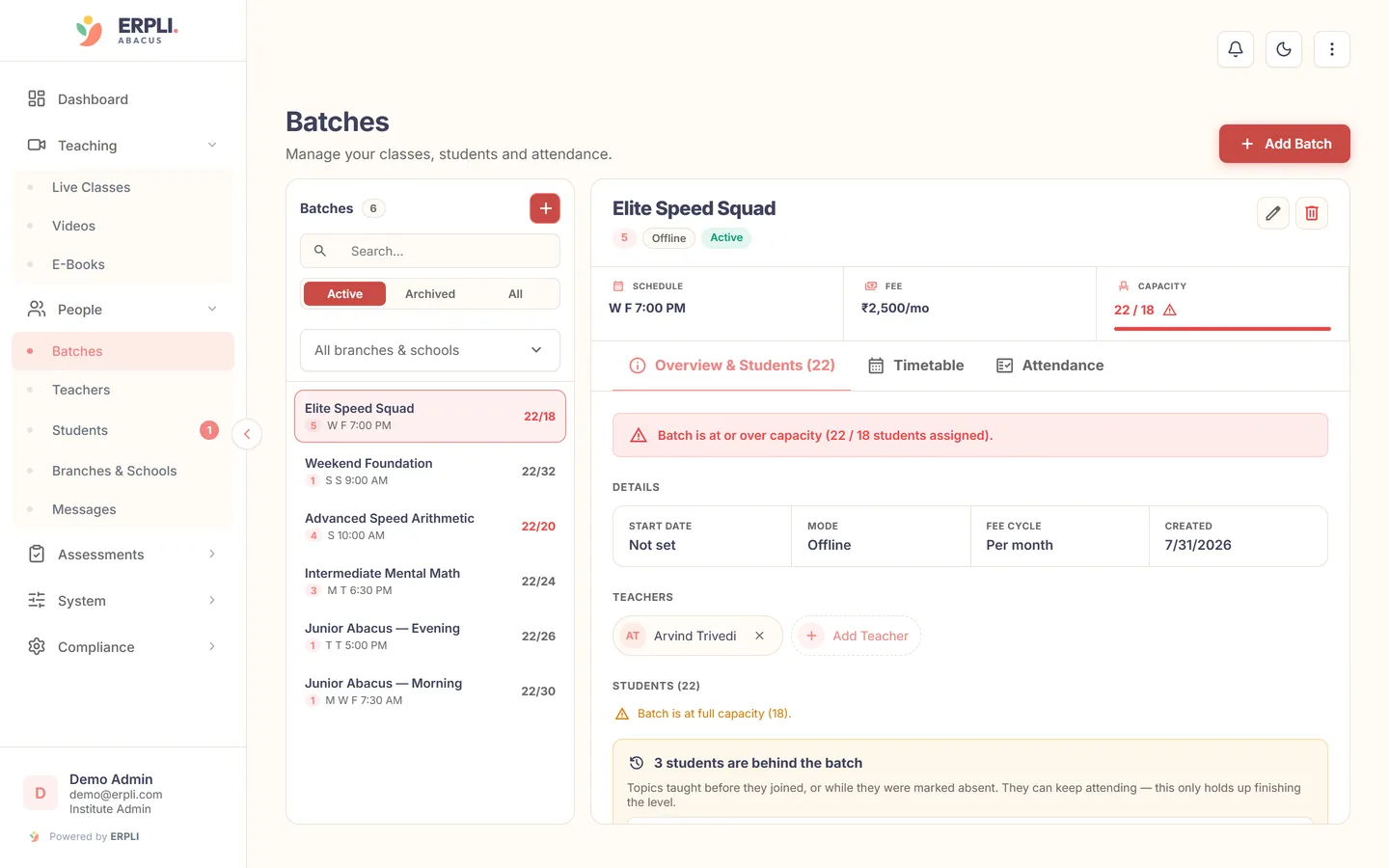
- Set fees once: monthly, quarterly and yearly fees per batch.
- Parents pay online, and the app sends fee reminders, so you never have to ask for fees in person.
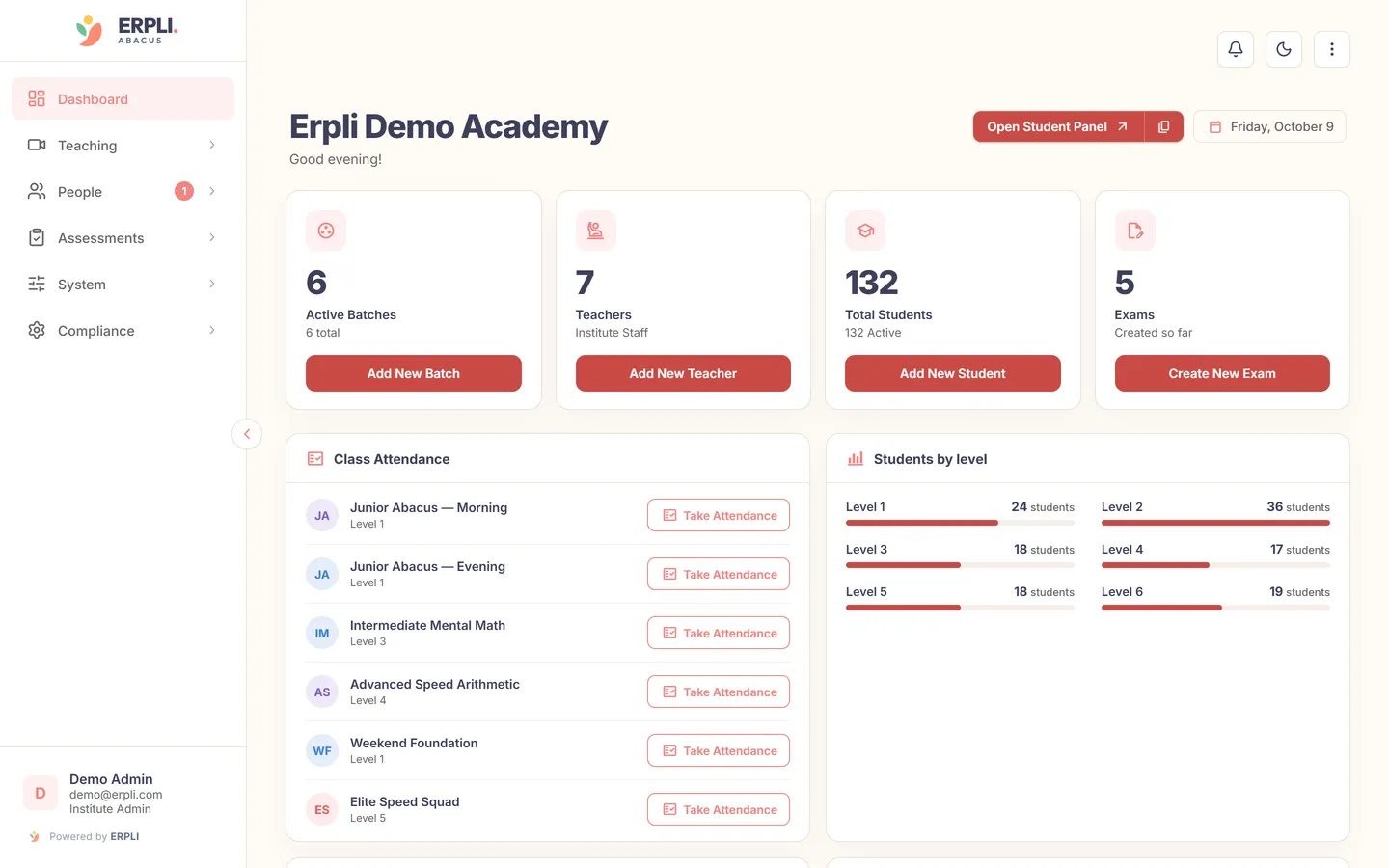
- See who has paid: "Fees this month" and pending fees on your dashboard.
- Move in one step: names, batches, levels and pending fees come across from one spreadsheet.
- Your brand everywhere: your academy name on the parent app, website and certificates.
See students, batches, attendance and fees for the full list.
ERPLI pricing for abacus academies
- ERPLI charges ₹50 per student/month up to 30 students, ₹45 up to 50, ₹40 up to 75, and ₹30 up to 100. For more than 100, custom quote available.
- Includes branded app, website, fee collection, practice modules, exams, and certificates.
- Optional Play Store launch is ₹2,000 one-time.
- Compare with your current admin costs and see if digital tools can save you money (see ERPLI pricing).
Common mistakes in abacus fee structure
Undercharging, especially in metros, reduces perceived value.
Not updating fees yearly—costs rise, so should your fees.
Complex or hidden charges frustrate parents.
Ignoring discounts or payment tracking leads to confusion.
Not communicating fee changes well in advance.
Use clear, simple abacus fee structure documents and automated reminders for professionalism.
Consider GST registration if your annual turnover exceeds the threshold (see GST portal).