ERPLI

Short answer: The main difference in the abacus franchise vs own academy debate is between higher upfront costs and less control (franchise) versus more freedom and lower long-term costs (own brand). Typically, franchises offer ready-made systems and branding, while your own academy means full independence—but more effort. Below, we break down costs, profits, control and which path suits you best.

Side-by-side 3-year cost comparison
Here’s a typical breakdown for a single centre in a Tier 1 or Tier 2 Indian city, with 60 active students. Actuals vary by brand and city.
| Item | Franchise (3 yrs) | Own Academy (3 yrs) |
|---|---|---|
| Franchise Fee | ₹1,50,000 – ₹5,00,000 | ₹0 |
| Setup/Training | ₹30,000 – ₹60,000 | ₹30,000 – ₹60,000 |
| Royalty (per year) | ₹30,000 – ₹60,000 | ₹0 |
| Materials (books, kit) | ₹1,00,000 – ₹1,50,000 | ₹75,000 – ₹1,20,000 |
| Marketing | ₹40,000 – ₹1,00,000 | ₹60,000 – ₹1,20,000 |
| Software (e.g. ERPLI) | ₹97,200 (₹45×60×36) | ₹97,200 (₹45×60×36) |
| Other recurring | ₹60,000 – ₹1,20,000 | ₹60,000 – ₹1,20,000 |
| Total (3 years) | ₹5,07,200 – ₹10,90,200 | ₹3,22,200 – ₹5,97,200 |
- Franchises may also require minimum student fees and fixed curriculum.
- Own academies can set their own pricing, syllabus and branding.
What do you get with a franchise?
- Well-known brand name, which can help with initial trust.
- Ready-made syllabus, materials, teacher training and exams.
- Marketing guidelines, but rarely any real help getting students.
- Strict rules: you must follow their curriculum, branding, and sometimes pricing.
- Royalty payments (fixed per year or per student), usually 10–20% of gross fees.
- Typically, you cannot switch to your own brand later without penalty.
What do you get with your own academy?
- Total control over your syllabus, teaching style and fees.
- You choose your own materials, software and marketing approach.
- Full ownership of your brand—change anything, anytime.
- No franchise fee or royalty payments; keep all profits.
- You must handle curriculum, exams, certificates, and marketing yourself.
- With platforms like ERPLI, you can automate much of the admin, practice, exams and certificates, making this path easier and more scalable.
What franchises don't tell you before you sign
Not every abacus franchise works this way. But many smaller franchise brands do, and we have seen these practices first-hand. We won't name anyone. If you are talking to a franchise, ask about each one before you sign.
- You can't teach online. Many franchises bar you from online classes or limit you to your local area. Online is now a bigger market than offline, and you'd be locked out of it.
- They control your Google Business Profile. Some franchises take over the profile and put their own number on it. The enquiries your centre earns go to them first.
- The franchise owner teaches too. Some franchisors run their own classes on the side, using your area, your name and your reviews to win students for themselves.
- They take a cut even with "no royalty". If there's no royalty, the money comes from somewhere else. Students are made to buy the brand's T-shirt, uniform, bag and abacus. Parents pay more, and you get the blame.
- Franchise-only competitions. Your students can only enter the brand's own competitions, often for a fee, and can't take part in open events. As a teacher you should be free to send students anywhere.
- No help getting students. Most of what you get is a teacher training course, books and kit at a high price. Finding students is still your job.
- Profit sharing that is hard to justify. One case from Maharashtra: a woman running a centre had to give 25% of her profit to the franchise owner, a close relative. She did all the teaching and all the marketing.
If the franchise you're considering does any of these, the brand name rarely makes up for what you give away.
Profit, brand and control: Who wins?
- Profit: Own academies keep all student fees minus direct costs. Franchises lose 10–20% to royalties.
- Brand: Franchises use someone else’s brand, and often their Google profile and phone number too. Own academies build their own reputation (see branding tips).
- Control: Franchises impose rules. Own academies decide everything—curriculum, teaching, fees, holidays.
- Growth: Franchises may support expansion, but often charge extra for new branches. Own brands can scale freely, especially with tools like ERPLI.
Who should choose a franchise?
- First-time business owners who want step-by-step guidance.
- Those with limited time for curriculum development.
- Entrepreneurs who value brand recognition over independence.
- People who prefer a structured, less risky route, even if profits are lower.
- Those in cities where the franchise brand is already trusted and advertised.
Who should start their own abacus academy?
- Experienced teachers or tutors who want full creative and business freedom.
- People who want to maximise profit per student and grow their own brand.
- Entrepreneurs willing to invest in marketing and local reputation.
- Anyone frustrated by franchise restrictions on teaching, pricing, online classes or competitions.
- Teachers who want to teach online across India, not just in one local area.
- Those interested in multi-location growth without extra franchise fees.
Practical steps to set up either model
Franchise steps
- Research brands, compare fees, speak to existing franchisees.
- Sign agreement, pay franchise fee, attend training.
- Set up centre as per brand guidelines.
- Start classes and follow all franchise rules.
Own academy steps
- Register your business (see Udyam registration).
- Design syllabus or use a ready-made one (like ERPLI’s syllabus).
- Set up centre, choose software and materials.
- Market locally—use Google Business Profile for visibility.
- Manage students, fees, exams and certificates—ERPLI automates these.
How ERPLI supports both models
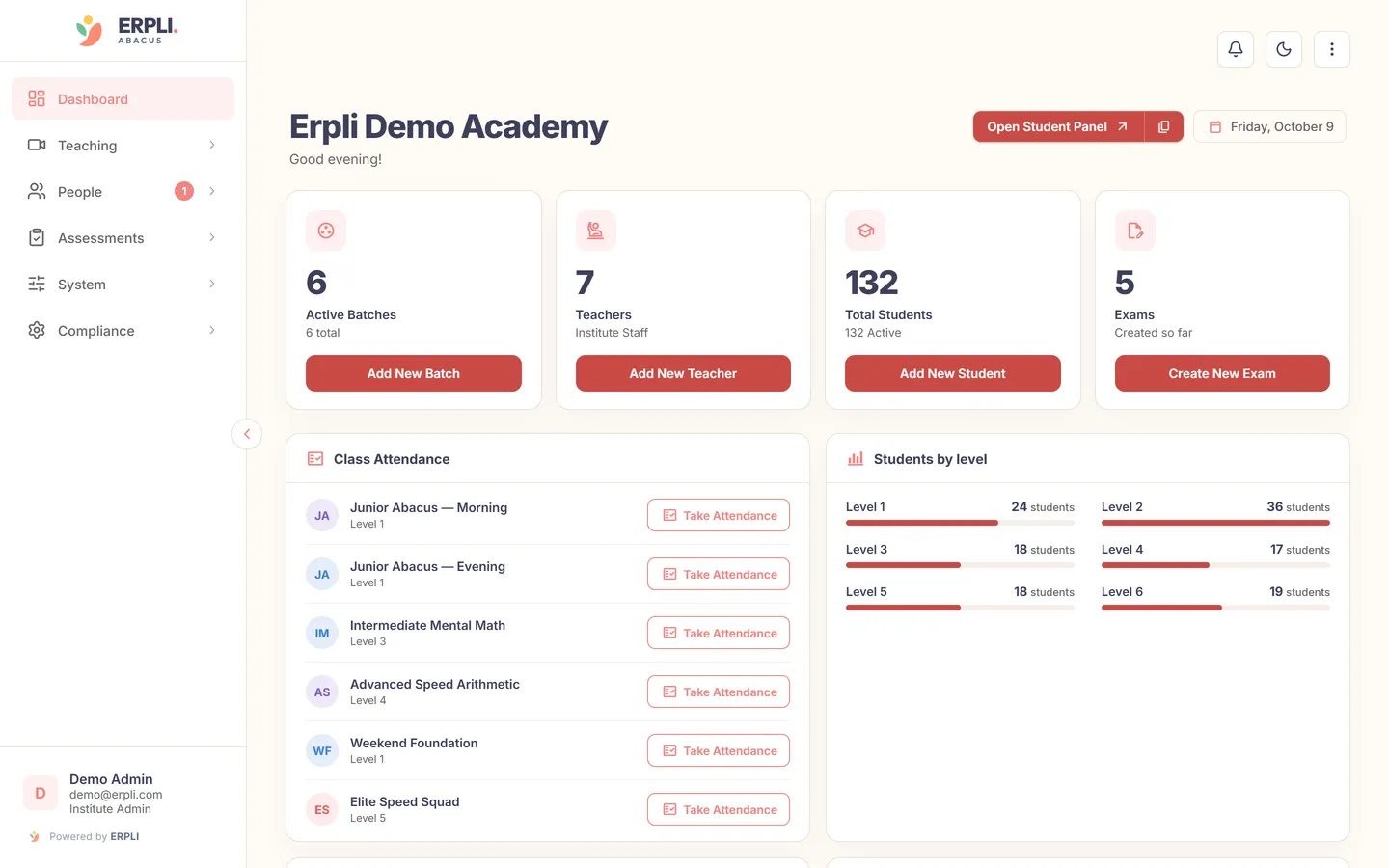
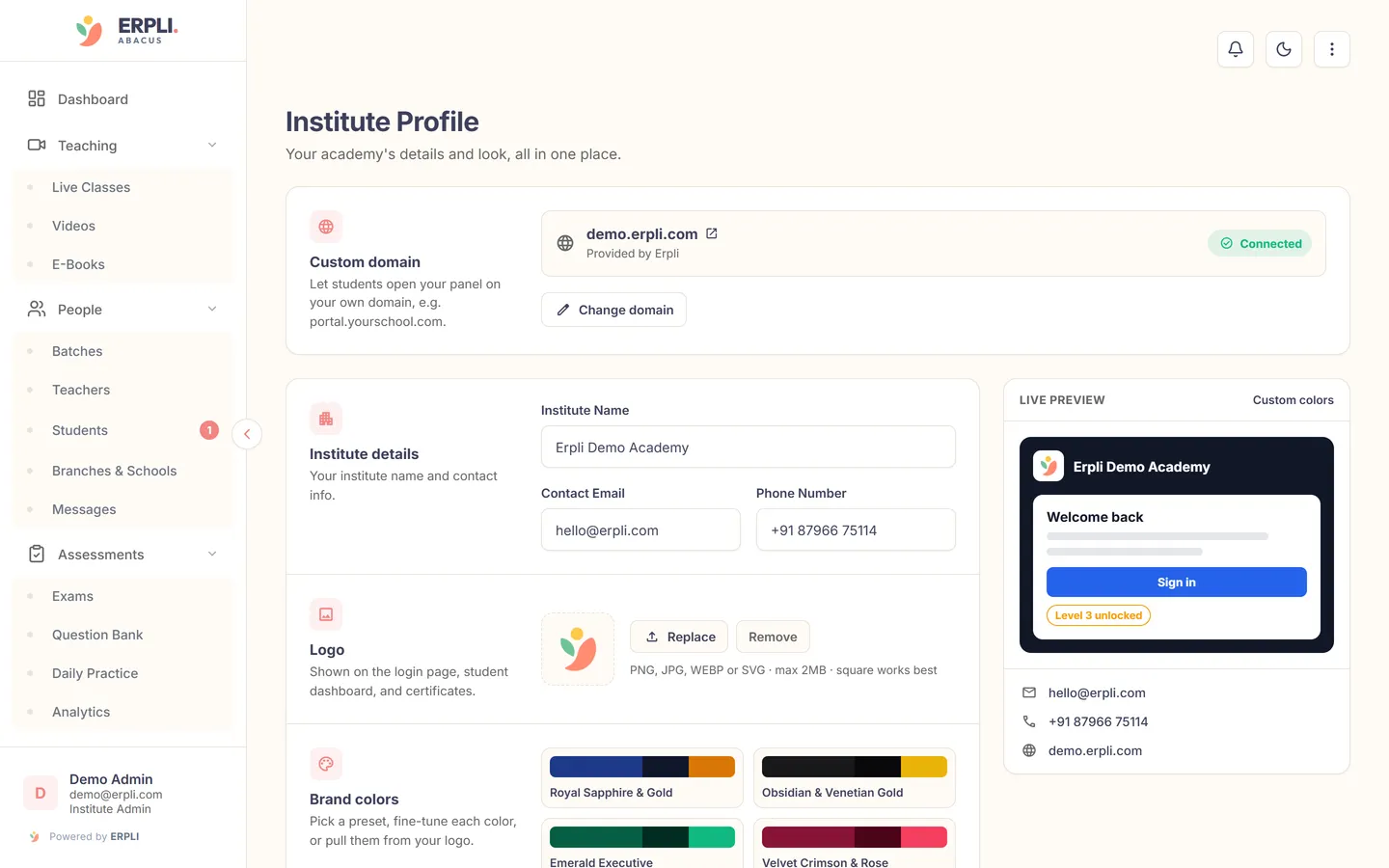
- Franchises: Manage multiple branches, batch-wise reporting, and royalty tracking with ERPLI’s franchise management tools.
- Own academies: Create custom-branded websites, automate syllabus, exams, certificates and fee collection.
- All users get level-based practice, exams, and certificates for students.
- Costs start at ₹50 per student per month, all features included. See full pricing.