ERPLI

Short answer: Abacus levels are structured stages that guide students from basic bead movement to advanced mental maths. Most academies follow a 10-level syllabus, where each level builds specific skills, increases speed, and introduces new concepts. Here you will find what is taught at each level, typical duration, and example sums.

Abacus Levels Overview Table
| Level | Key Skills | Typical Duration | Example Sum |
|---|---|---|---|
| Level 1 | Bead values, simple add | 3 months | 2 + 3 |
| Level 2 | Subtraction, 2-digit add | 3–4 months | 15 – 7 |
| Level 3 | Carry/borrow, 3-digit | 3–4 months | 123 + 45 |
| Level 4 | Multiplication intro | 4 months | 23 × 2 |
| Level 5 | Division intro, mixed op | 4 months | 48 ÷ 4 |
| Level 6 | Larger numbers, speed | 3–4 months | 345 + 567 |
| Level 7 | Decimals, advanced mult | 4 months | 12.5 × 4 |
| Level 8 | Mental abacus (anzan) | 4 months | 75 + 43 (mental) |
| Level 9 | Complex sums, speed test | 4 months | 2,345 – 1,234 |
| Level 10 | Mastery, competitions | 4–6 months | 1,234 × 12 |
Abacus Level 1: Basics and Bead Movement
- Focus: Understanding abacus structure, bead values, and basic addition (single digit).
- Typical duration: 3 months, with weekly classes and home practice.
- Skills: Holding the abacus, finger movement, adding numbers up to 10.
- Example sum: 2 + 3 = 5.
- Students gain confidence in manipulating beads and recognising number positions.
Abacus Level 2: Subtraction and Two-Digit Sums
- Focus: Introduction to subtraction, simple two-digit addition and subtraction.
- Duration: 3–4 months, varies by pace and practice.
- Skills: Subtracting numbers, adding numbers up to 99.
- Example sum: 15 – 7 = 8.
- Teachers often use visual aids and oral drills at this stage.
Abacus Level 3: Carry, Borrow, and Three-Digit Numbers
- Focus: Introduction to carryover and borrowing concepts, 3-digit addition/subtraction.
- Duration: 3–4 months.
- Skills: Adding and subtracting 100s, understanding regrouping.
- Example sum: 123 + 45 = 168.
- Students start solving sums like 254 – 68 using stepwise bead movement.
- Abacus syllabus for all levels is available for detailed reference.
Abacus Level 4: Multiplication Begins
- Focus: Introduction to multiplication using abacus techniques.
- Duration: Typically 4 months.
- Skills: Multiplying one- and two-digit numbers (e.g., 23 × 2).
- Example sum: 23 × 2 = 46.
- Emphasis on repeated addition and multiplication tables.
- Students learn patterns for faster calculation.
Abacus Level 5: Division and Mixed Operations
- Focus: Basic division and combining addition, subtraction, multiplication.
- Duration: 4 months.
- Skills: Dividing up to 2-digit numbers, solving mixed operation sums.
- Example sum: 48 ÷ 4 = 12.
- Practice includes story sums and real-life examples.
- Mastery of this level enables students to solve 4–5 step sums.
Abacus Level 6: Larger Numbers and Speed Building
- Focus: Handling large numbers, improving calculation speed.
- Duration: 3–4 months.
- Skills: Addition and subtraction of up to 4-digit numbers, time-bound practice.
- Example sum: 345 + 567 = 912.
- Timed worksheets and group competitions are introduced.
- Unlimited abacus practice helps students increase speed.
Abacus Level 7: Decimals and Advanced Multiplication
- Focus: Introduction to decimal numbers, advanced multiplication strategies.
- Duration: 4 months.
- Skills: Multiplying decimals (e.g., 12.5 × 4), multi-digit multiplication.
- Example sum: 12.5 × 4 = 50.
- Students use special formulas for decimal placement.
- Start of more complex word problems.
Abacus Level 8: Mental Abacus (Anzan) Techniques
- Focus: Transition from physical abacus to mental calculation.
- Duration: 4 months.
- Skills: Visualising the abacus, solving sums mentally, speed enhancement.
- Example sum: 75 + 43 (mental calculation).
- Flash cards and visual drills are used extensively. Learn more about mental abacus research.
Abacus Level 9: Complex Sums and Speed Tests
- Focus: Solving complex, multi-step problems under time limits.
- Duration: 4 months.
- Skills: Handling large numbers, mixed operations, speed tests.
- Example sum: 2,345 – 1,234 = 1,111.
- Practice involves 10–20 step problems and mock tests.
- Certificates and progress tracking are important at this level.
Abacus Level 10: Mastery and Competitions
- Focus: Mastery of all abacus techniques, competition preparation.
- Duration: 4–6 months, varies by student readiness.
- Skills: Multi-digit multiplication/division, mental maths, and contest strategies.
- Example sum: 1,234 × 12 = 14,808.
- Students participate in internal and external competitions.
- ERPLI can generate custom certificates for graduates.
How ERPLI Supports Abacus Levels
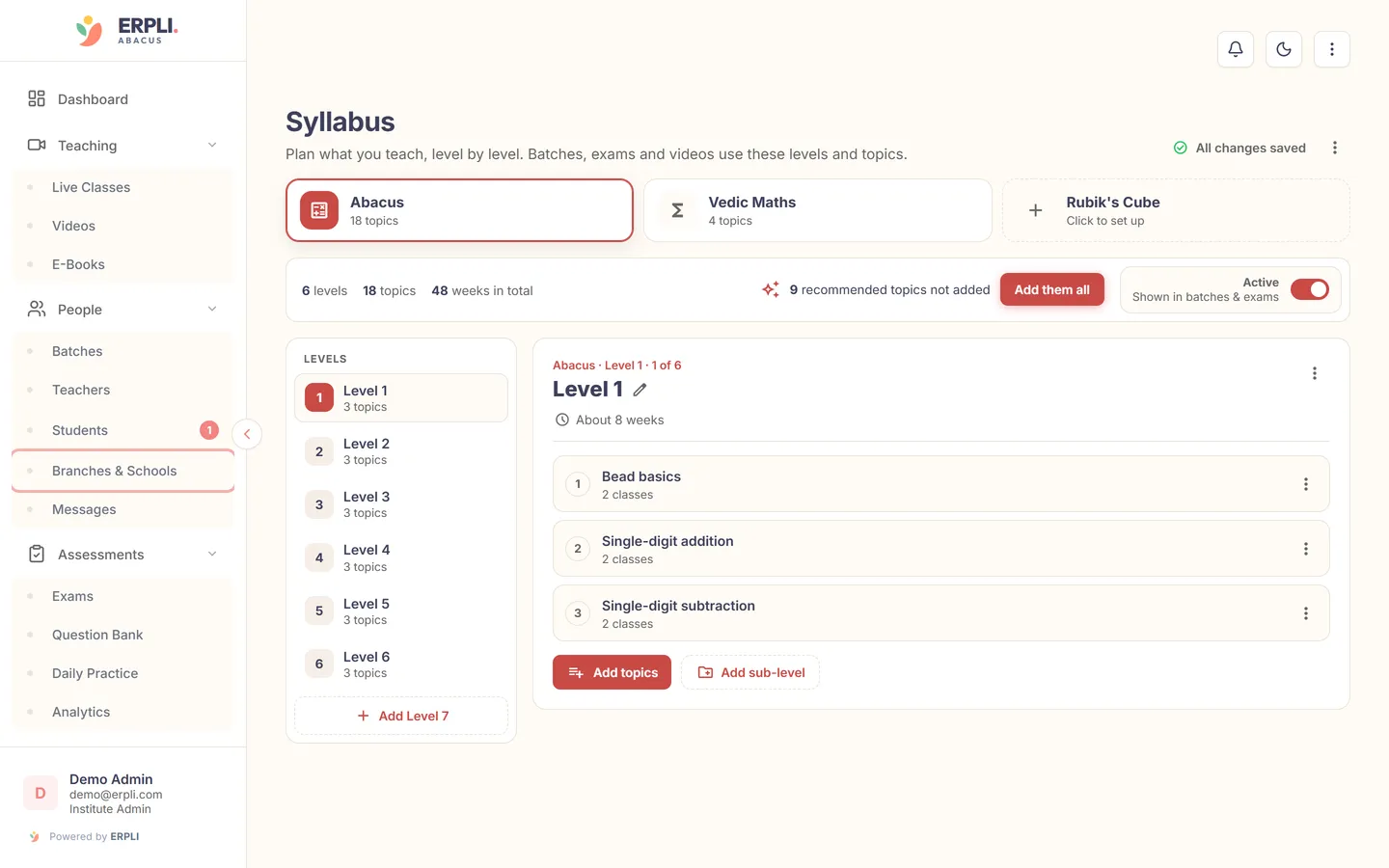
- ERPLI offers a complete abacus syllabus by level and lets you manage batches, assign practice, and track progress by level.
- Teachers can assign level-wise worksheets, schedule exams, and issue certificates digitally.
- Pricing is ₹50 per student/month up to 30 students, with volume discounts—see full pricing.
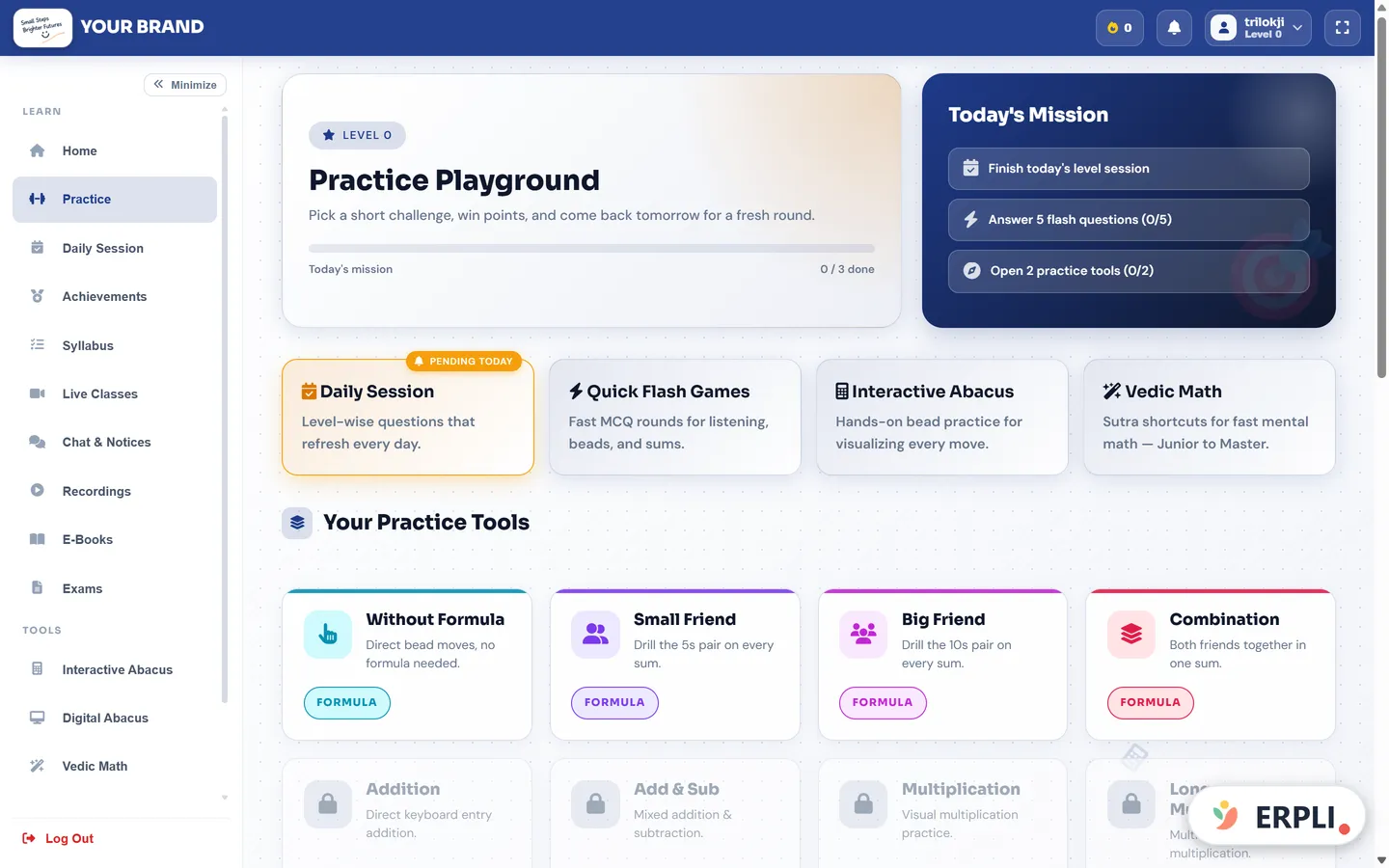
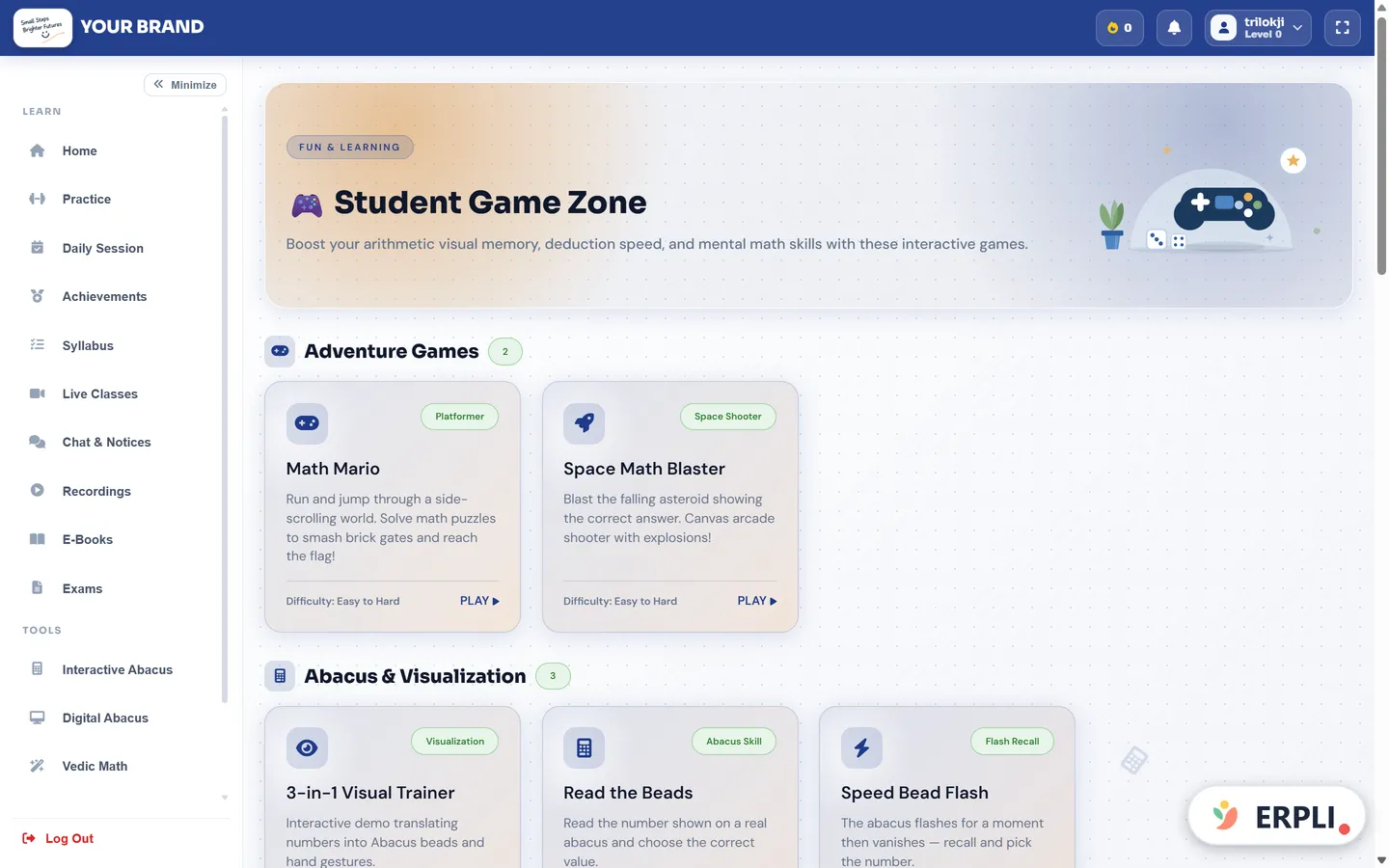
- Includes digital abacus, live/recorded classes, and unlimited practice modules.