ERPLI

Short answer: An abacus teacher salary in India ranges from ₹8,000 to ₹50,000 per month, depending on batch size, fees, and expenses. Your net income depends on the number of batches, city, and whether you run your own academy or tutor from home. Below, we break down real monthly earnings, costs, and profits for 1, 3, and 5 batches, so you can plan confidently.

Typical Abacus Teacher Salary: Batch-Wise Breakdown
Abacus teacher income depends mostly on the number of batches and students. Most batches have 10–15 students, with fees ranging from ₹600–₹1,200 per month (varies by city and academy reputation).
Below is a realistic monthly income table for a home tutor or small academy:
| Batches | Students/Batch | Monthly Fee (₹) | Gross Income (₹) | Typical Expenses (₹) | Net Income (₹) |
|---|---|---|---|---|---|
| 1 | 12 | 800 | 9,600 | 1,600 | 8,000 |
| 3 | 12 | 800 | 28,800 | 4,120 | 24,680 |
| 5 | 15 | 1,000 | 75,000 | 8,125 | 66,875 |
- Fees and expenses vary by city and setup.
- Expenses include books/materials (~₹500/student/year), software (ERPLI from ₹50/student/month), and basic utilities.
- Net income is after typical costs, not including rent (if running from home).
Abacus Teacher Salary at Academies and Schools: What Really Happens
The numbers above are for teachers who run their own batches. If you work for an academy or a school, pay looks very different.
Large academies often pay very little
Many medium and large abacus academies, especially in North India, pay teachers only ₹5,000–₹10,000 per month. In return they offer free teacher training and a certificate that says you are a certified abacus teacher. The academy treats the training as part of your pay. That makes it a good place to learn, but a hard place to earn.
How schools and academies structure pay
Most employers use one of two models:
- Per student: around ₹200 per student per month. Your pay grows only when your batches grow.
- Fixed salary: a monthly amount that depends on the city tier (Tier 1, Tier 2 or Tier 3), the location, and your own qualifications.
Before you accept an offer, ask which model they use and work out what you would earn with your real batch size.
Independent teachers have more options
Once you are trained and certified, you are not tied to one employer. You can start your own institute, teach from home, or take classes at any school that wants an abacus programme. Teachers who go independent usually earn far more than the ₹5,000–₹10,000 academy range, because the fee goes to them and not to a franchise. See how to run abacus classes as a private tutor and setting up your own academy.
Where schools are most open to abacus
Schools in Maharashtra and Karnataka have been the most progressive. Many have added abacus to their curriculum and actively hire abacus teachers. Schools in the North, including Delhi, are still behind, so teachers there often depend on academies or their own home batches. If you are in Maharashtra or Karnataka, approaching schools directly can be one of the fastest ways to fill batches. Read more about abacus programmes for schools.
Main Expenses: What to Budget For
- Books & Materials: ₹400–₹600 per student per year (workbooks, abacus, practice sheets).
- Software (ERPLI): from ₹50 per student per month. See ERPLI pricing for details.
- Utilities: ₹500–₹2,000/month (electricity, water, etc., varies by city).
- Marketing: Optional—flyers, WhatsApp ads, digital marketing.
- Certification & Exams: Some academies charge exam fees; ERPLI includes digital certificates and exam tools (see digital certificates).
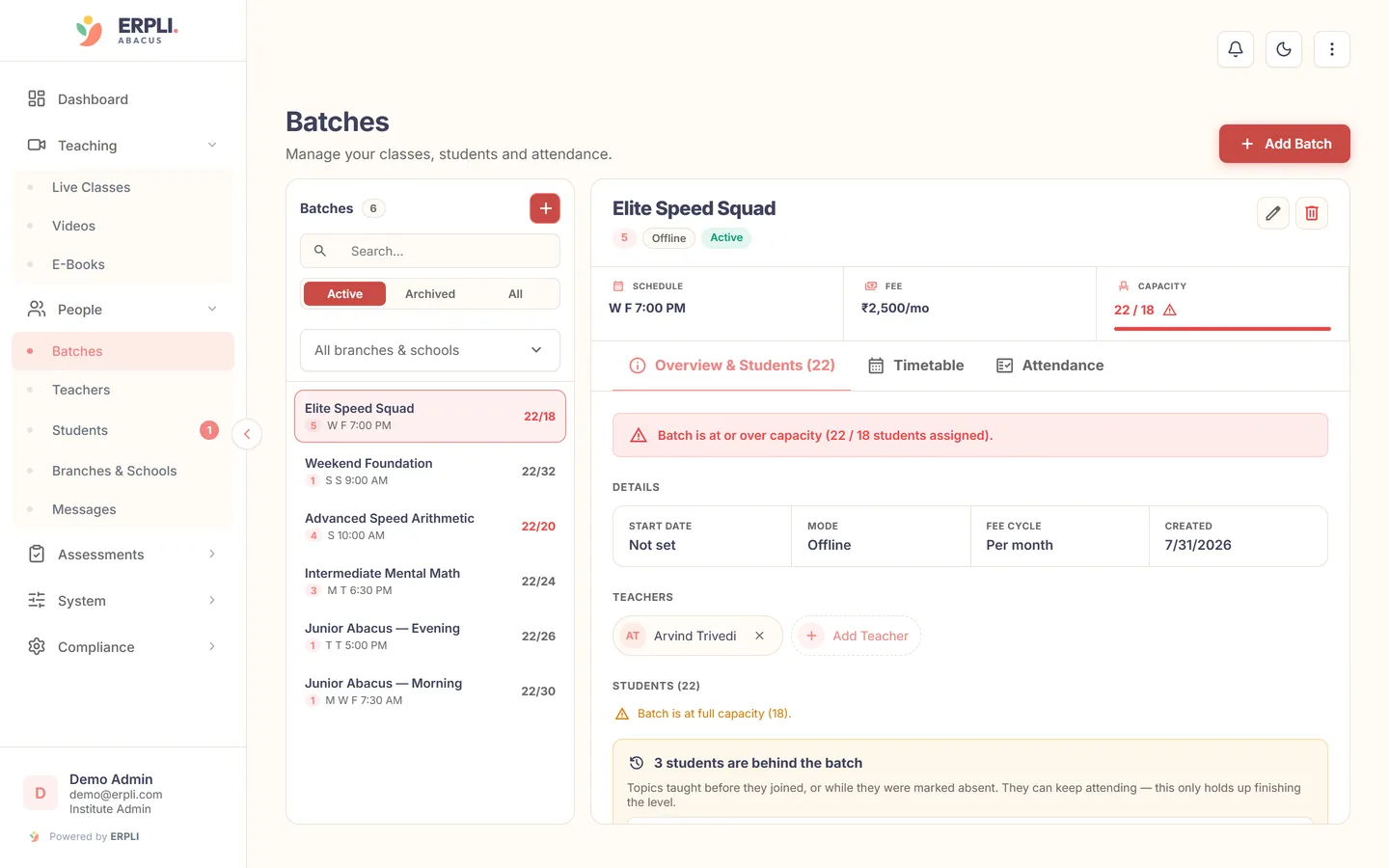
Software like ERPLI can automate attendance, fees, practice, and certificates, reducing admin work for solo teachers.
Growing Your Abacus Teacher Income
- Add more batches or increase students per batch (up to 15–20, depending on your comfort level).
- Offer online classes to reach students beyond your locality.
- Upsell Vedic Maths or mental maths modules for higher fees (see Vedic Maths module).
- Collaborate with schools or coaching centres to get group enrollments.
- Brand your academy for higher fees—ERPLI offers branding tools (see academy branding).
Net Profit Calculation: Realistic Scenarios
Let’s look at three common setups:
1. Home Tutor (1 batch)
- 12 students × ₹800 = ₹9,600/month gross
- Expenses: Books (₹500 × 12 ÷ 12 = ₹500/month), ERPLI (₹50 × 12 = ₹600), utilities (₹500)
- Net: ₹9,600 – ₹1,600 = ₹8,000/month
2. Small Academy (3 batches)
- 36 students × ₹800 = ₹28,800/month gross
- Expenses: Books (₹1,500/month), ERPLI (₹45 × 36 = ₹1,620), utilities (₹1,000)
- Net: ₹28,800 – ₹4,120 = ₹24,680/month
3. Growing Centre (5 batches)
- 75 students × ₹1,000 = ₹75,000/month gross
- Expenses: Books (₹3,125/month), ERPLI (₹40 × 75 = ₹3,000), utilities (₹2,000)
- Net: ₹75,000 – ₹8,125 = ₹66,875/month
Factors That Affect Abacus Tutor Earnings
- City/Town: Metro fees are 20–40% higher than Tier 2/3 cities.
- Batch Size: More students per batch increases profit, but quality matters.
- Experience & Certification: Certified teachers can charge higher fees.
- Home vs. Rented Centre: Running from home saves rent (often ₹5,000–₹15,000/month in cities).
- Franchise Fees: Some brands charge ₹20,000–₹50,000 one-time or annual fees; running your own brand (see academy branding) avoids this.
- Software & Automation: Low-cost tools like ERPLI (from ₹50/student/month) reduce admin hassle and support growth.
Can You Increase Abacus Class Profit?
- Reduce costs: Buy books in bulk, use digital worksheets (see digital worksheets).
- Batch scheduling: Weekdays for older kids, weekends for younger, maximising classroom use.
- Referral programs: Offer discounts for student referrals.
- Online + Offline: Hybrid classes attract more students and higher fees.
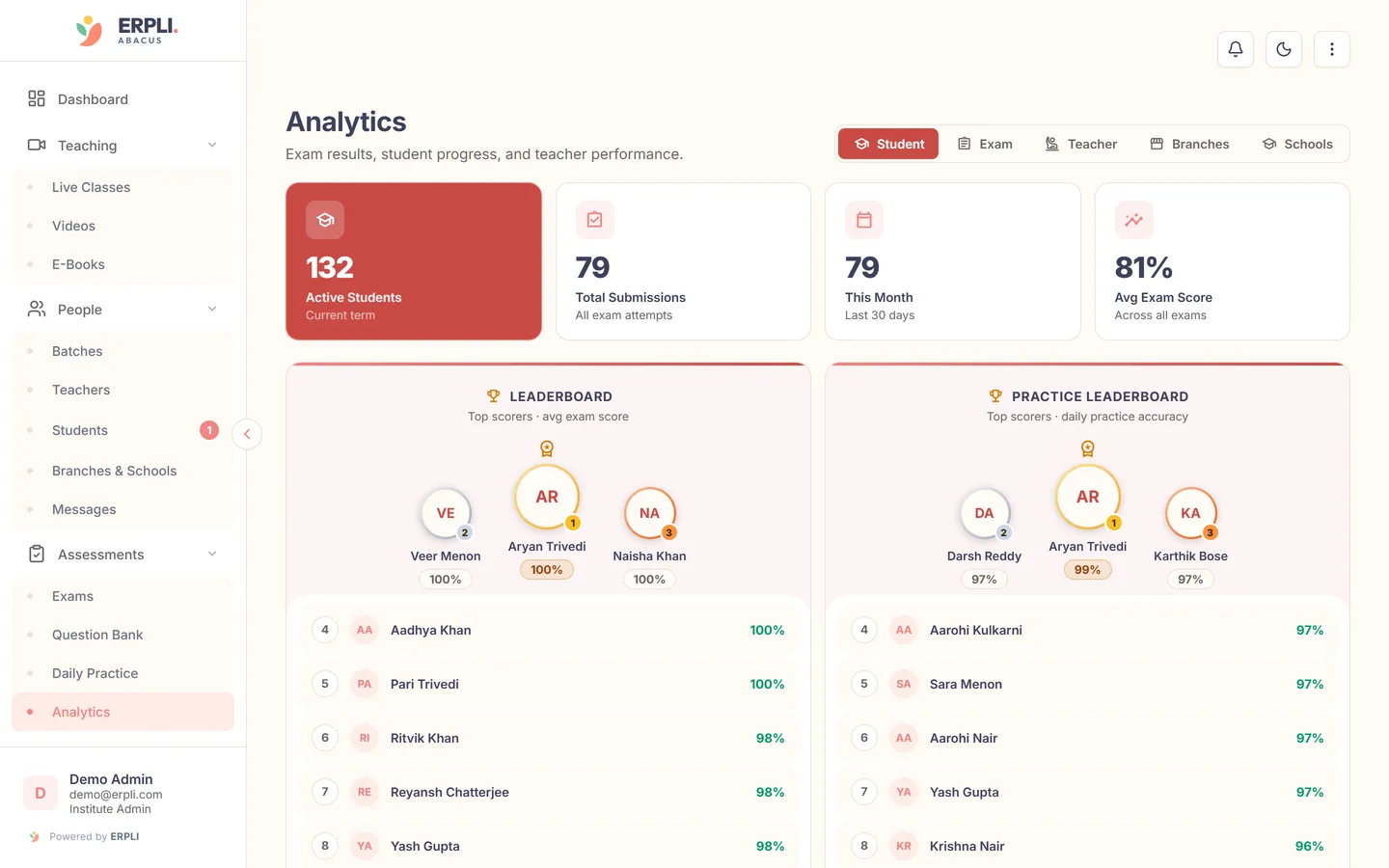
- Use analytics: Track student progress and batch performance to retain students longer (see academy analytics).
Is Abacus Teaching a Good Career for Women?
- Flexible timings—work mornings, evenings, or weekends.
- Low setup cost—start from home with 10–12 students.
- High demand for after-school maths skills in Indian cities.
- Opportunity to grow—add more batches or even open a centre.
- Many women scale up to 50–100 students within 2–3 years.
- Software like ERPLI helps even solo teachers manage everything from fees to certificates.