ERPLI

Short answer: A level-wise abacus worksheet changes three things as students move up: the number of digits, the number of rows in each sum, and which formulas are allowed. Level 1 sticks to single digits and direct bead moves. By Level 4 students are doing 3–4 digit sums with mixed small and big friend formulas, against a timer.
Most worksheets found online fail for one reason: they mix formulas a child has not learned yet. A Level 1 student who hits "+4" before learning small friends gets stuck, guesses, and loses confidence. This guide gives you a level-by-level spec you can use to write or check any sheet.
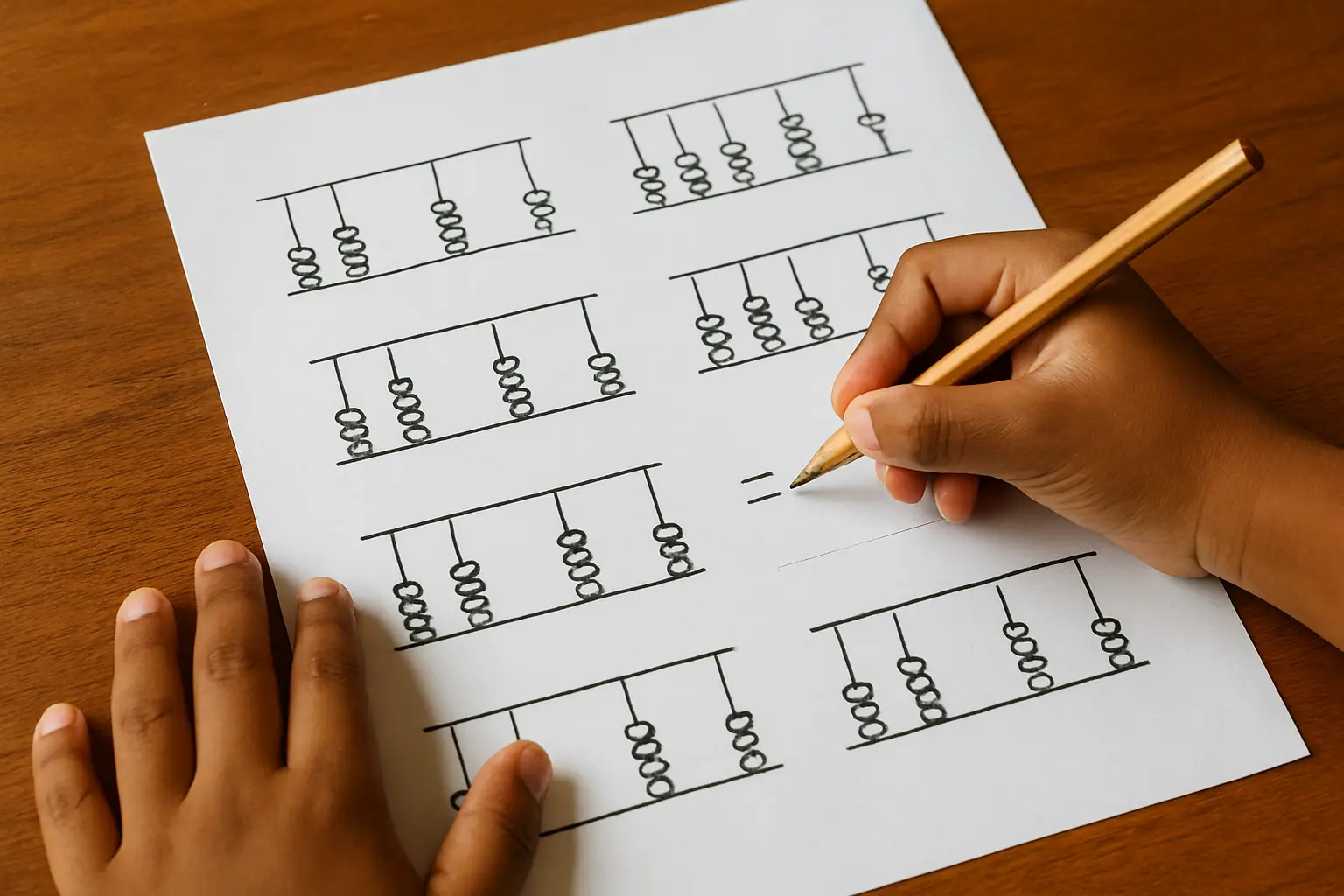
What goes on a worksheet at each level?
Level names differ between institutes. Match these to your own syllabus.
| Level | Formulas allowed | Digits | Rows per sum | Sums per sheet | Time limit |
|---|---|---|---|---|---|
| Level 0 / Pre | Bead reading, direct only | 1 | 2–3 | 20 | None |
| Level 1 | Direct, small friends (+/−5) | 1 | 3–5 | 30 | None |
| Level 2 | Big friends (+/−10) | 1–2 | 4–5 | 40 | 10 min |
| Level 3 | Mixed (combination) formulas | 2 | 5 | 50 | 10 min |
| Level 4 | All formulas | 2–3 | 5–7 | 50 | 8 min |
| Level 5+ | All, plus multiplication | 3–4 | 7–10 | 50–60 | 6–8 min |
The rule behind the table: raise only one thing at a time. If you add a new formula, keep the digits the same that week. If you add a digit, use only formulas the batch already knows.
What does a good Level 1 sum look like?
Here are three Level 1 sums, each checked so no formula is needed before it is taught:
| Sum | What it tests |
|---|---|
| 3 + 1 − 2 = | Direct moves only |
| 2 + 5 − 1 = | Using the upper bead |
| 4 + 3 = | Small friend: +3 = +5 − 2 |
A worksheet that drops "8 + 7" into a Level 1 sheet is testing big friends, which the student has not met. This is the most common mistake on free sheets and is why children who are doing fine in class sometimes struggle with homework.
What should be on the page besides the sums?
- A header box with the student's name, batch, level, date, and time taken
- Your academy name and logo. The sheet goes home, and parents see it.
- Vertical sums for early levels. They match how beads sit on the abacus. Horizontal sums come later, for mental maths.
- Answer boxes in a fixed place, so checking 30 sheets is quick
- A "time taken" box from Level 2. Speed is what parents ask about.
- No answer key on the student's copy. Print it separately.
How many sheets should a student do each week?
A pattern many institutes use:
- Class days: one sheet done in class, checked on the spot
- Non-class days: one short sheet of 10–15 sums as homework
- Before a level exam: two timed sheets in exam format
Daily short practice beats one long sheet on the weekend. A 10-minute sheet every day keeps finger movement automatic. One 60-minute sheet on Sunday mostly builds tiredness.
Why do teachers stop making worksheets by hand?
Writing sums that follow formula rules takes time, and checking them takes longer. If one batch needs a "small friend +3 only" sheet and another needs "mixed, 2 digits, 5 rows", you are writing two sheets from scratch.
Inside ERPLI Abacus, the worksheet generator does this for you:
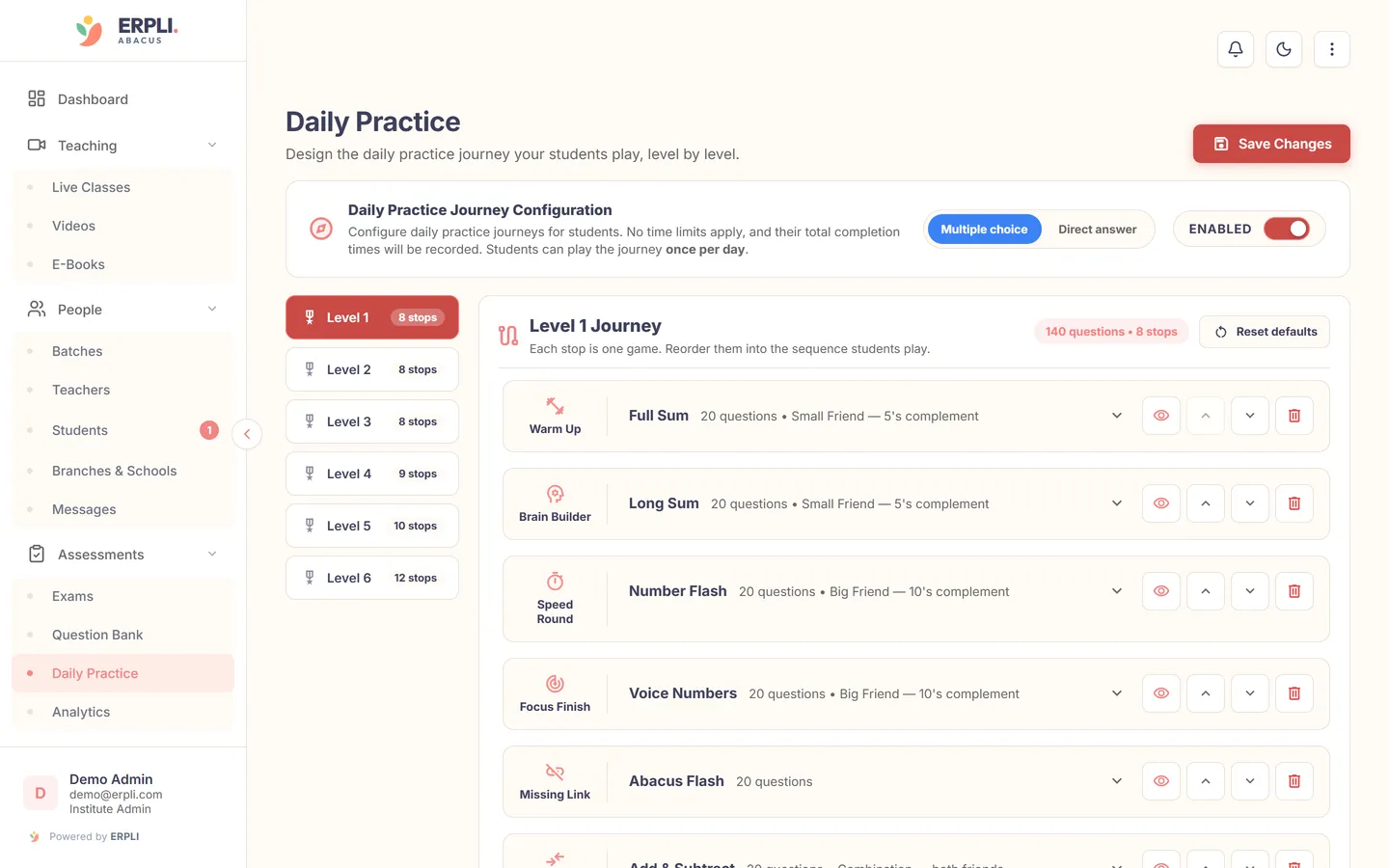
- Pick the formula (direct, small friends, big friends or combinations), the digits and the rows, and sheets are made in seconds
- Print in vertical or horizontal layout on A4, with an eco mode that saves toner
- "Read the beads" questions with soroban diagrams for early levels
- Vedic maths sheets (Nikhilam, Ekadhikena, crosswise) for institutes that teach both
- Your logo, academy name and a student details box on every sheet
- A separate answer key in one click
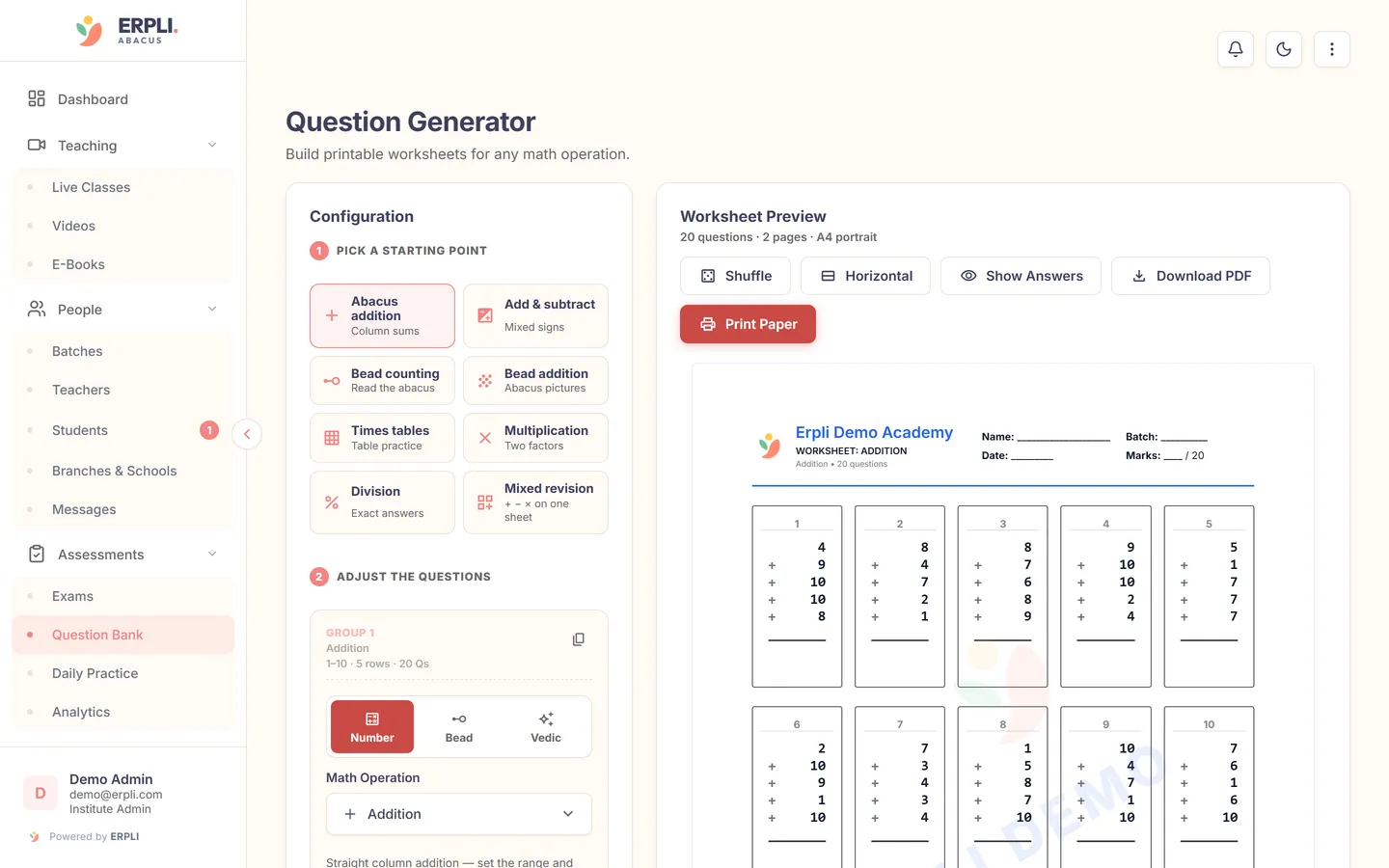
For homework you don't want to check by hand, assign online practice instead. ERPLI has 22 abacus modules from Level 0 to Level 10. Each one makes fresh questions every time and checks answers automatically. You choose which modules each batch can open.
Printed sheet or online practice?
| Printed worksheet | Online practice | |
|---|---|---|
| Best for | Class work, early levels, finger technique | Daily homework, speed, Flash Anzan |
| Checking | By the teacher | Automatic |
| Shows if the abacus was used | Only in class | No, so pair it with class work |
| Works without a phone at home | Yes | No |
Most institutes use both: printed sheets in class to build the hand, online practice at home to build speed. Online scores also show you which formula each child is weak on before the level exam.
Worksheets and practice come with every ERPLI Abacus plan, from ₹50 per student per month. See pricing.