ERPLI

An abacus question paper typically includes sections for basic arithmetic, mental calculation, and speed tests, with the number of questions and exam time adjusted by level. The format ensures students are tested on both accuracy and speed, matching their syllabus progression. Below, you’ll find common structures, time allocations, and sample questions for three key levels.
Key takeaways
- Each abacus question paper is divided into clear sections: addition/subtraction, multiplication/division (higher levels), and mental maths.
- Choose the question count and time limit to match the skills each group has covered.
- Sample questions help teachers set the right difficulty per level.
- Using a question bank or exam software saves time and maintains consistency.
- See more sample formats in the abacus syllabus and assignments modules.
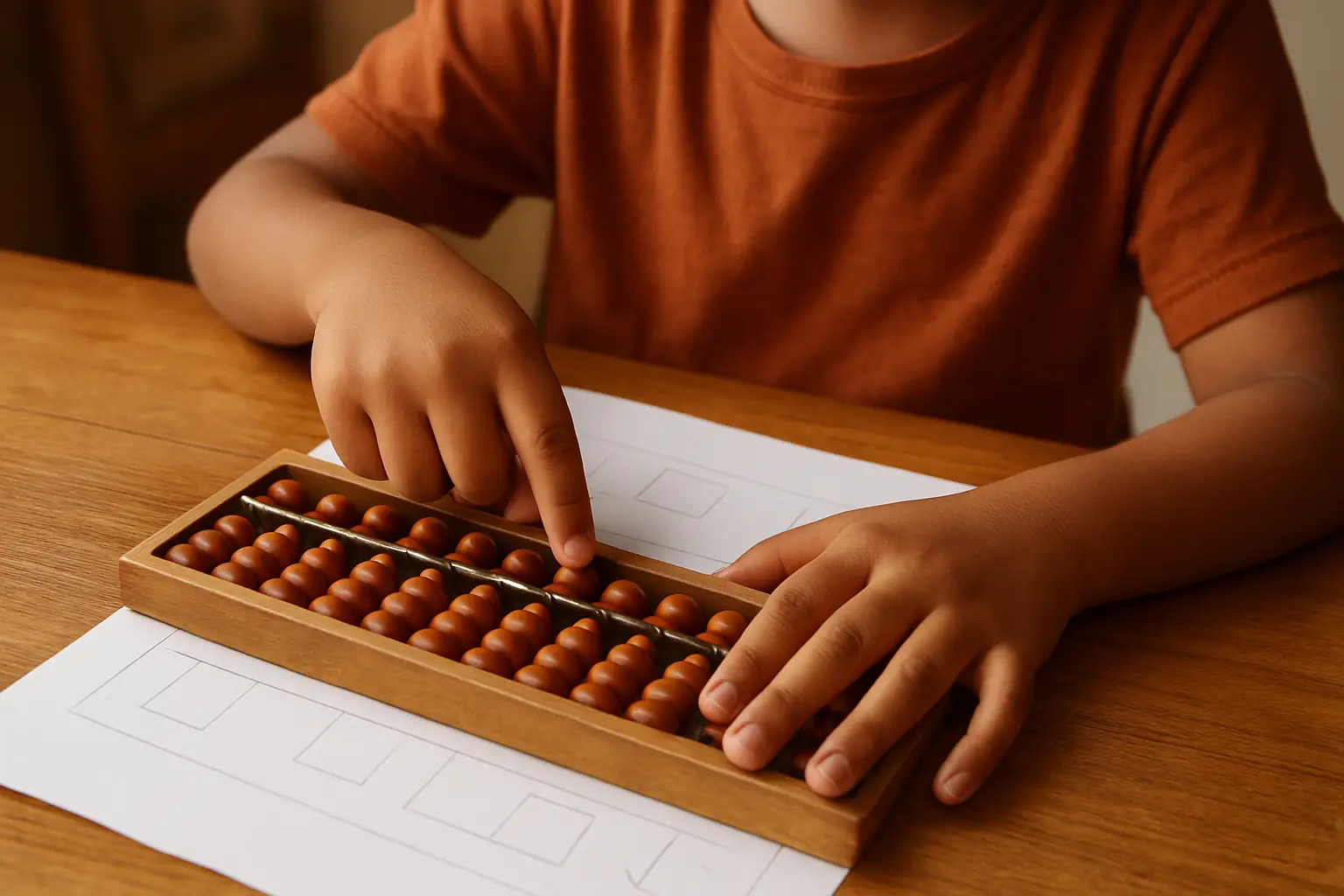
Typical Abacus Question Paper Structure
- Section 1: Basic operations (addition, subtraction)
- Section 2: Advanced operations (multiplication, division – for higher levels)
- Section 3: Mental calculation/Flash anzan
- Section 4: Word problems or application questions
- Each section has a set number of rows (questions) and marks allocated.
- The table gives example timings for a class assessment. Adjust them after a trial with students at the same level.
- Instructions are printed at the top: allowed tools (abacus/mental only), time, and whether rough work is permitted.
| Level | Sections | Rows (Questions) | Time (Minutes) |
|---|---|---|---|
| Level 1 | Addition, Subtraction | 20-30 | 20-25 |
| Level 3 | Add/Subtract, Simple Multiplication | 30-40 | 25-30 |
| Level 5/6 | All Ops, Mental, Word Problems | 40-50 | 35-45 |
Sample Abacus Question Paper: Level 1
- Section 1: Addition
- 5 + 3 = ___
- 12 + 7 = ___
- 23 + 16 = ___
- Section 2: Subtraction
- 9 - 4 = ___
- 18 - 5 = ___
- 27 - 13 = ___
- Section 3: Simple Mental Calculation
- Start with 7, add 4, then subtract 2. Write the final total.
- Format tips: Use large, clear font. Leave space for workings. 20–25 questions, 20 minutes.
Sample Level 1 abacus question papers are available in the abacus syllabus by level on ERPLI.
Sample Abacus Question Paper: Level 3
- Section 1: Addition/Subtraction (2-digit numbers)
- 34 + 21 = ___
- 67 - 29 = ___
- Section 2: Simple Multiplication
- 6 × 7 = ___
- 12 × 3 = ___
- Section 3: Mental Calculation
- 15 + 8 - 5 = ___ (solve mentally)
- Section 4: Short Word Problem
- Riya has 12 beads. She gets 7 more. How many now?
- Format tips: 30–35 questions, 25–30 minutes, mix of direct and application questions.
Sample Abacus Question Paper: Level 5/6
- Section 1: Mixed Operations (3-digit numbers)
- 123 + 456 = ___
- 789 - 234 = ___
- Section 2: Multiplication/Division
- 24 × 5 = ___
- 144 ÷ 12 = ___
- Section 3: Mental/Flash Calculation
- Flash 4 numbers: 23, 45, 12, 9 (total = ___)
- Section 4: Word Problem
- A box has 48 beads. If 6 students share equally, how many beads per student?
- Format tips: 40–50 questions, 35–45 minutes, include at least 2 word problems.
How a published competition paper differs from a class test
A former competitor’s LinkedIn profile describes an eight-minute round at the Rajasthan state-level UCMAS event in 2008. That recollection gives teachers an example of a timed competition. Check the relevant event’s current rules before preparing students for it. See the competitor’s LinkedIn profile.
An official 2024 UCMAS Canada graduate-category practice paper also specifies eight minutes. It gives 10 marks for each addition or subtraction answer and five for each multiplication or division answer. This is the marking scheme for that particular paper. For a class assessment, choose a marking scheme that reflects the skills you taught and print it at the top. See the UCMAS Canada practice paper.
Before printing, ask another teacher to solve a copy using only the permitted tools. Check that question numbers match the answer key and that students can tell where each answer goes. For a projected flash section, write down the interval and replay policy for the teacher. The four-number example above totals 89.
Setting Up and Managing Abacus Exams Efficiently
- Use a question bank to randomise questions and avoid repetition.
- ERPLI’s abacus exam software lets you create level-wise abacus exam papers in minutes.
- Automated marking and instant result generation save time for teachers.
- Add your own question sets or use built-in samples from the assignments module.
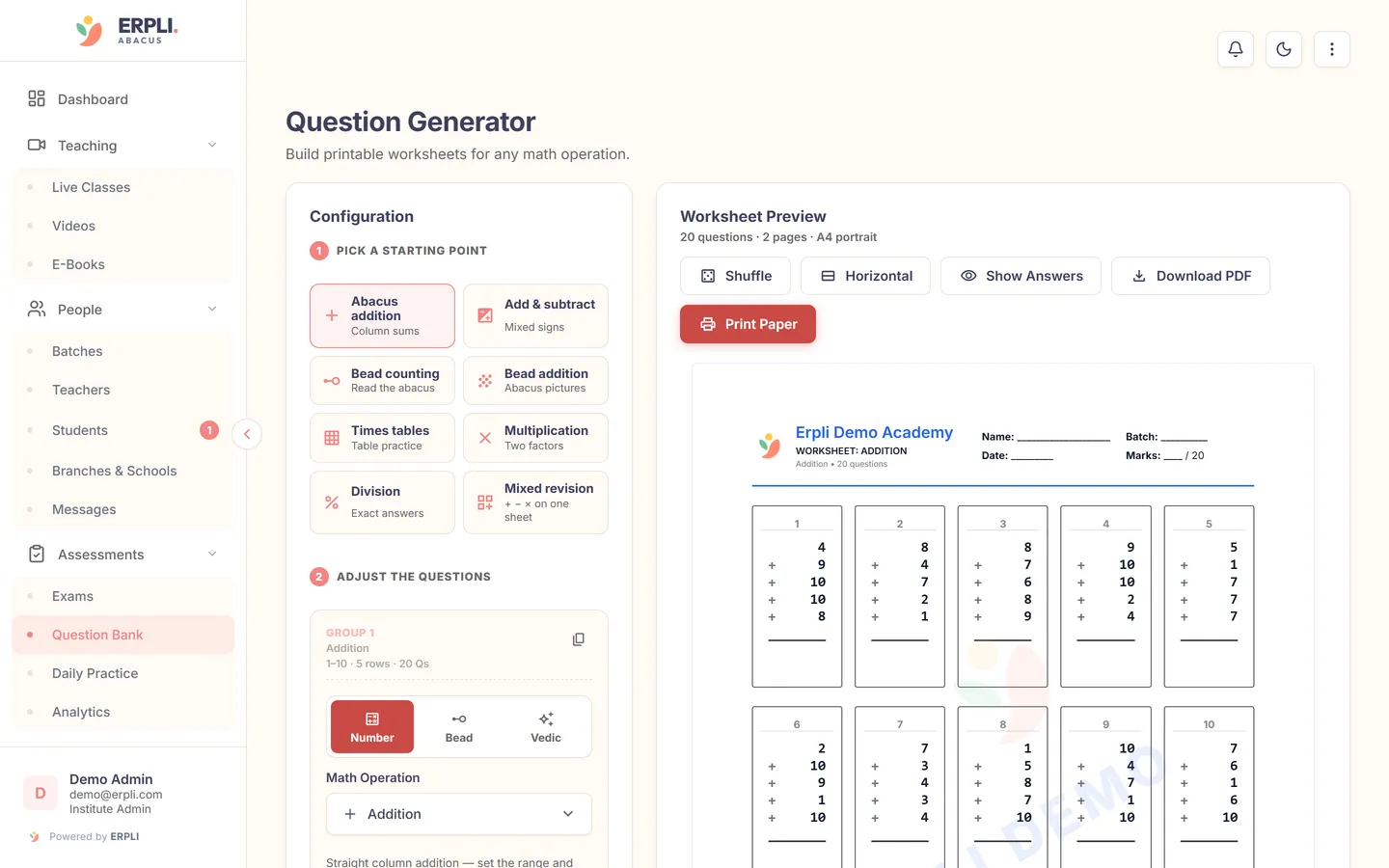
Tips for Creating Effective Abacus Exam Papers
- Align questions to the abacus syllabus for each level.
- Mix direct sums with mental and word problems.
- Print clear instructions about abacus use and time allotted.
- Adjust difficulty and question count as students progress.
- Use digital tools to manage, print, and archive question papers.
- For online or hybrid academies, consider digital abacus and e-books for practice (interactive abacus e-books).
Time Management and Marking Scheme
- For a simple class test, you can award one mark per correct answer and leave incorrect answers unpenalised.
- Allocate more time for higher levels due to complexity.
- For speed rounds, set a section-specific timer (e.g., 5 minutes for mental flash).
- Encourage students to attempt all questions; partial marks for workings may be given at lower levels.
- Use ERPLI’s analytics to track student progress and identify common errors.
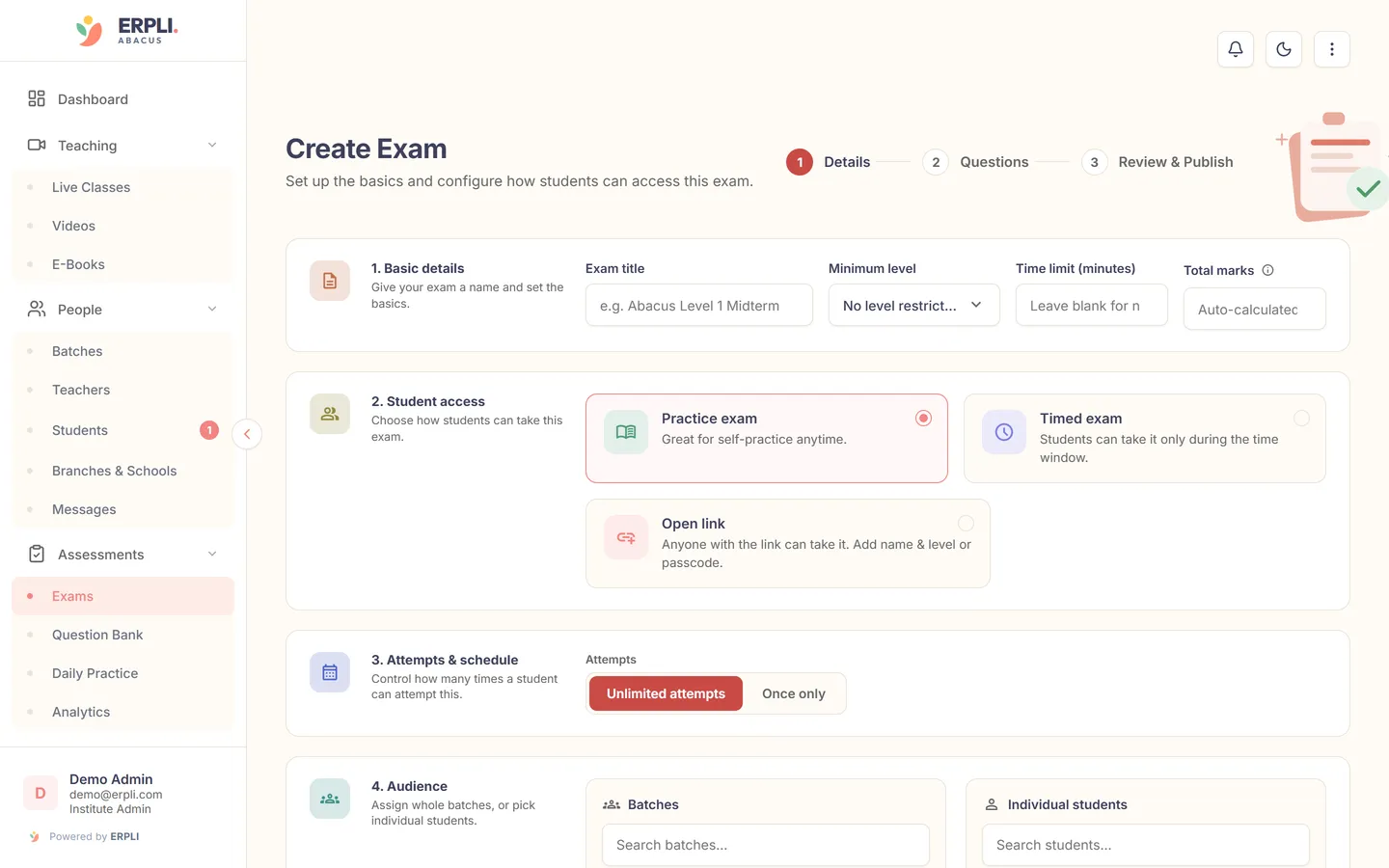
Common Variations by Academy and Board
- Some academies use only mental abacus for higher levels.
- Board exams may have stricter timings and proctoring.
- Regional or franchise brands may follow a standardised abacus question paper template.
- Always check if your board has specific requirements for question format or marking.
- You can customise ERPLI templates to match your academy’s needs.
Next step
Start by aligning your abacus question papers to your syllabus and level goals. Try digital tools to streamline exam creation and marking for your academy.