ERPLI

To organise an abacus competition at your academy, decide the format, set clear rules for each level, and prepare rounds with fair timing and marking. Use digital tools or paper-based methods to manage registration, results, and certificates. Both online and offline abacus competitions work well—plan according to your students’ needs.
Key takeaways
- Define competition type: single academy, inter-academy abacus contest, or abacus olympiad.
- Set levels, rounds, and time limits for fair assessment.
- Prepare question sets and marking scheme in advance.
- Arrange for prizes, certificates, and clear communication of results.
- Use digital platforms like ERPLI to run abacus exams online, track scores, and issue certificates.

Choosing Your Abacus Competition Format
- Decide between in-house, inter-academy abacus contest, or open abacus olympiad.
- Online competitions allow participation from remote students; offline events bring community and celebration.
- A hybrid event can use an online preliminary round followed by in-person finals.
- For large-scale events, consider an abacus championship with multiple rounds and age categories.
Planning Levels, Rounds, and Timing
- Divide students by current abacus level or age group.
- Typical structure: 2–3 rounds (speed, accuracy, mental abacus).
- Set reasonable time limits: 10–20 minutes per round depending on age and difficulty.
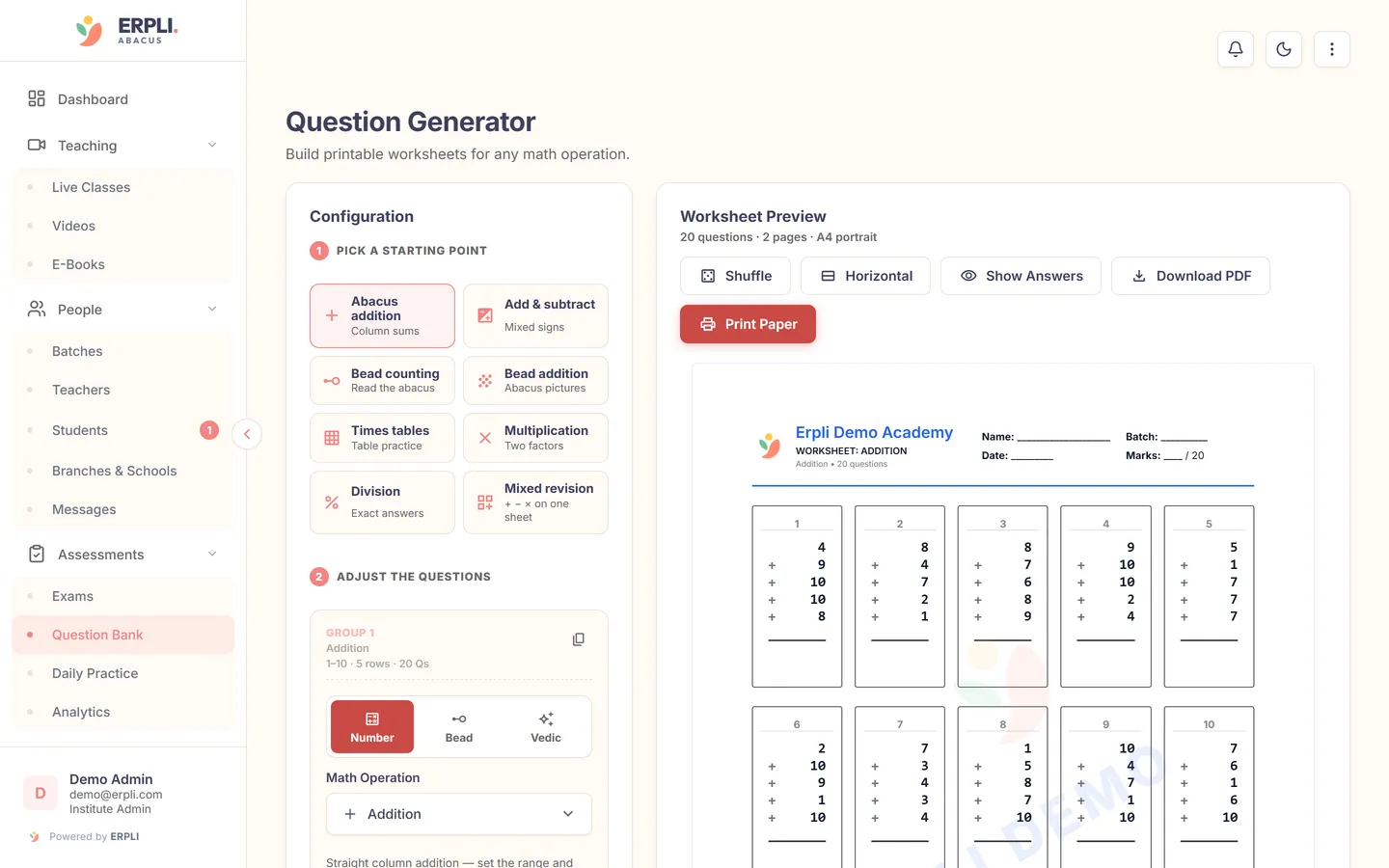
- Use a question bank to ensure fairness and variety.
- For online events, use software to automate timing and question delivery.
| Level | Round Type | Time (min) | Sample Task |
|---|---|---|---|
| Beginner | Speed Calculation | 10 | 2-digit addition/subtract |
| Intermediate | Mental Abacus | 15 | 3-digit sums |
| Advanced | Accuracy Round | 20 | Mixed operations |
Publish the category rules with registration
A parent writing about the 2024 Canadian UCMAS national competition described categories grouped by age and level. For a local academy event, use that idea to explain eligibility in the registration form. State which taught level counts, the date you use to confirm it, and who should approve a category change if a student moves up before the event. Read the parent’s account on LinkedIn.
Give every category its own instructions and sample question. For a physical-abacus round, specify the allowed equipment and have invigilators check each desk before the start. For a mental round, tell families that students will put away their frames and show them how answers should be entered. One published example is the visual round described by UCMAS Odisha and North-East India, where competitors calculate mentally without an instrument. See the organiser’s event format.
Decide how you will resolve tied scores and print the rule on the event sheet. If you plan an online round, include a supervised practice login and explain what happens when a device disconnects. Give the same instructions to every participant in that category.
Registration, Communication, and Fees
- Announce the abacus competition at least 3–4 weeks in advance.
- Use WhatsApp groups, email, and posters in your academy.
- Collect registration via Google Forms, WhatsApp, or ERPLI’s student list feature.
- Decide on entry fees (if any). Base the fee on your venue, staffing, materials, and awards budget.
- Share competition rules, schedule, and format clearly with parents and students.
Preparing Questions, Answer Keys, and Marking
- Build a question bank in advance, covering all syllabus topics and levels. ERPLI’s abacus exam software lets you run abacus exams online with automatic marking.
- For offline: print question sheets for each level and round.
- Prepare answer keys and marking schemes to ensure consistency.
- Appoint invigilators or use online proctoring tools for fairness.
Conducting the Competition: Online vs Offline
Offline (In-Person)
- Arrange halls/classrooms with enough seating and abacus kits.
- Use timers, loud signals for start/stop, and clear invigilation.
- Collect answer sheets promptly and keep them secure.
Online
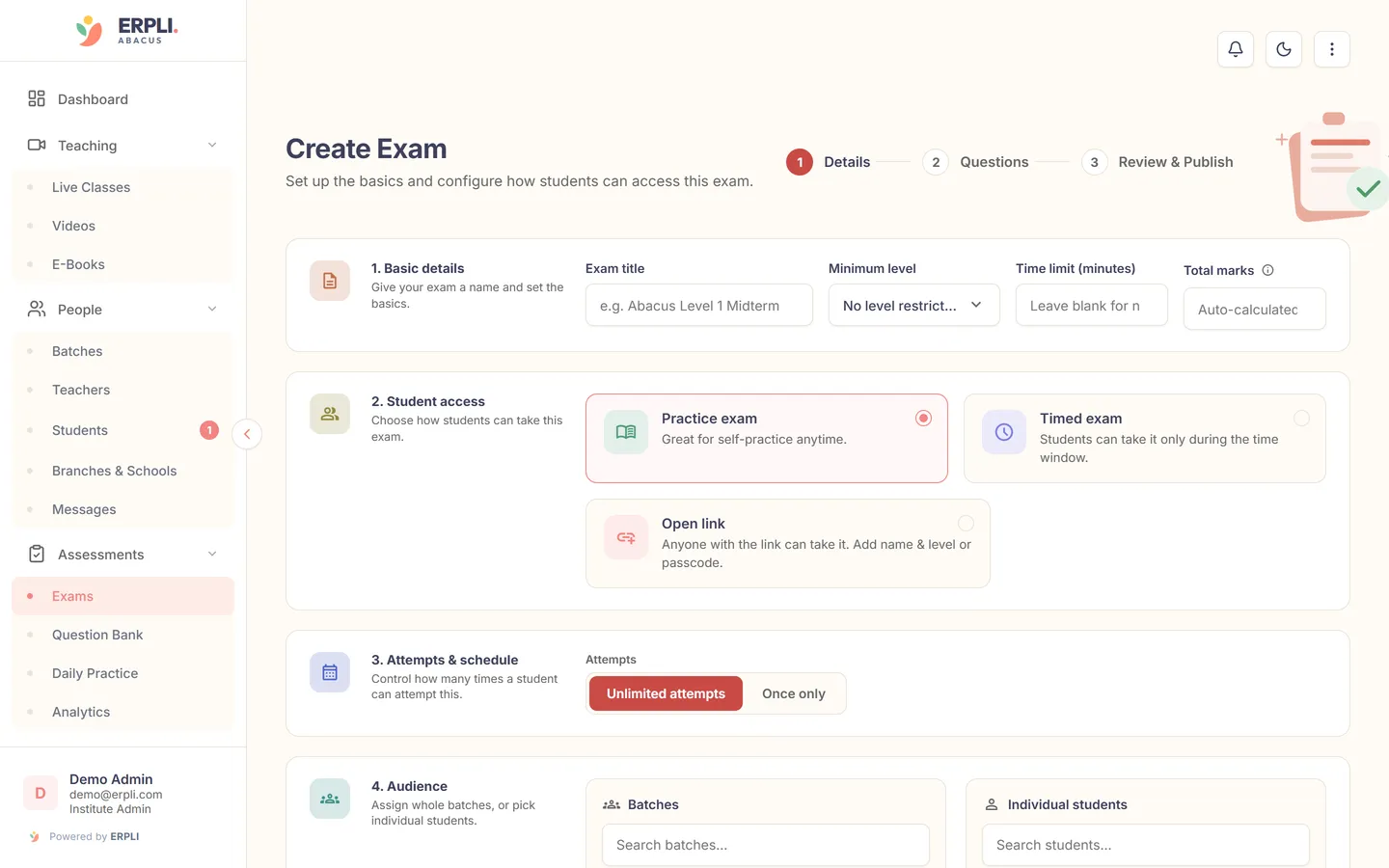
- Use platforms like ERPLI for live abacus competitions, with digital question delivery, live timing, and instant result calculation.
- Ensure all participants have stable internet and required devices.
- Use video calls for monitoring if needed.
Scoring, Results, and Certificates
- Enter scores into a spreadsheet or use abacus exam software to automate.
- Announce results promptly to maintain excitement and transparency.
- Recognise top scorers in each category and all participants with digital or printed certificates.
- ERPLI enables you to design and issue abacus certificates instantly with your academy branding.
| Award Type | Criteria | Typical Prize |
|---|---|---|
| Champion | Highest overall score | Trophy + Certificate |
| Runner-up | Next highest score | Medal + Certificate |
| Participation | All attendees | Certificate |
Prizes, Medals, and Celebration
- Arrange for trophies, medals, and certificates for winners and participants.
- For a big event, consider sponsored gifts (books, abacus kits, bags).
- Hold a prize distribution ceremony—offline or online—to celebrate achievements and motivate students.
- Ask families for permission before sharing identifiable student photos or results publicly.
Managing Logistics and Feedback
- Form a small organising team (teachers, admin staff, volunteers).
- Prepare a checklist: venue, abacus kits, question papers, answer keys, timers, refreshments.
- Collect feedback from parents, students, and staff for improvements.
- For franchises, coordinate with other branches using abacus franchise management software for smooth multi-location events.
Next step
Ready to organise your first abacus competition? Start by planning levels and rounds, then choose the right tools for registration, exams, and certificates. Try ERPLI for a seamless online or offline event—book a free demo to see how it works.