ERPLI

Flash anzan is a mental abacus training method where numbers flash rapidly on a screen and the student calculates the total in their mind. Start with enough time to picture each bead move. Shorten the interval once the learner can finish comparable sets accurately.
Key takeaways
- Flash anzan builds advanced mental abacus skills for fast, accurate calculation.
- Start practice at 2.0 seconds per number, then reduce the interval as skill improves.
- Use free online tools for flash calculation and anzan practice.
- Try short, focused sessions and take a break when accuracy starts to drop.
- ERPLI’s Flash Anzan practice module tracks speed and accuracy for each student.
- Patience and gradual speed increases are key to lasting improvement.

What is flash anzan?
- Flash anzan means “mental calculation” in Japanese and is rooted in the soroban abacus method (source).
- In a typical session, numbers (usually 1–3 digit) appear in quick succession on a screen, and students mentally sum them.
- No writing, no abacus: only the mind is used, visualising beads and calculating instantly.
- Used in international competitions and by advanced abacus academies in India.
- Flash anzan is different from regular abacus practice because it focuses on speed, visualisation, and memory.
Training plan: Speed intervals from 2.0s to 0.2s
| Stage | Flash Interval | Typical Duration | Goal |
|---|---|---|---|
| Beginner | 2.0s/number | 1–2 weeks | Accuracy >90% at slow speed |
| Early Int. | 1.0s/number | 2–4 weeks | Maintain accuracy |
| Intermediate | 0.7s/number | 3–6 weeks | Improve focus, reduce slip |
| Advanced | 0.5s/number | 4–8 weeks | Consistent accuracy |
| Pro | 0.3–0.2s/num | Ongoing | High speed, low error |
- Start with 10–15 number sets, then increase up to 30–50 as students progress.
- Don’t rush: only decrease the interval when accuracy is stable.
- Treat these intervals and durations as examples. Adjust them to the student’s accuracy and comfort.
For ready-to-use online flash tools, try the Flash Anzan practice module on ERPLI.
What to record when the speed goes up
An adult learner who tracked flash anzan for about a year described recording answer accuracy and response time. Their scores varied from session to session even as they improved. That is one learner’s experience. In class, compare several short sets before changing the target pace. Read the learner’s Reddit discussion.
Try five sets of six single-digit numbers at the same interval. Record the number of correct totals and the time taken to enter each answer. Repeat with fresh sets at the next class. If both sessions are steady, shorten the interval by one step while keeping the digit count and set length fixed.
When a learner misses a total, replay the set at a slower pace and ask for the running total after each number. If the learner can follow at the slower pace, repeat at a manageable speed. If the same bead move causes a mistake again, practise that move separately on the physical abacus.
Essentials for effective anzan practice
- A distraction-free room and a large screen or device.
- A digital flash anzan tool that lets you set speed and number length.
- Timer and accuracy tracker (most online tools include these).
- Encourage students to keep their eyes on the screen during the sequence and visualise the bead moves.
- Use both individual and group practice for variety.
- For younger students, start with fewer numbers and longer intervals.
Common challenges and how to overcome them
- Losing track of numbers: Practice with smaller sets, then build up.
- Mental fatigue: Limit sessions to 10–15 minutes with breaks.
- Plateau at a certain speed: Stay at that interval for a week, then try again.
- Accuracy drops at higher speeds: Go back to previous interval, regain confidence, then advance.
- Distractions: Use headphones or quiet spaces to improve focus.
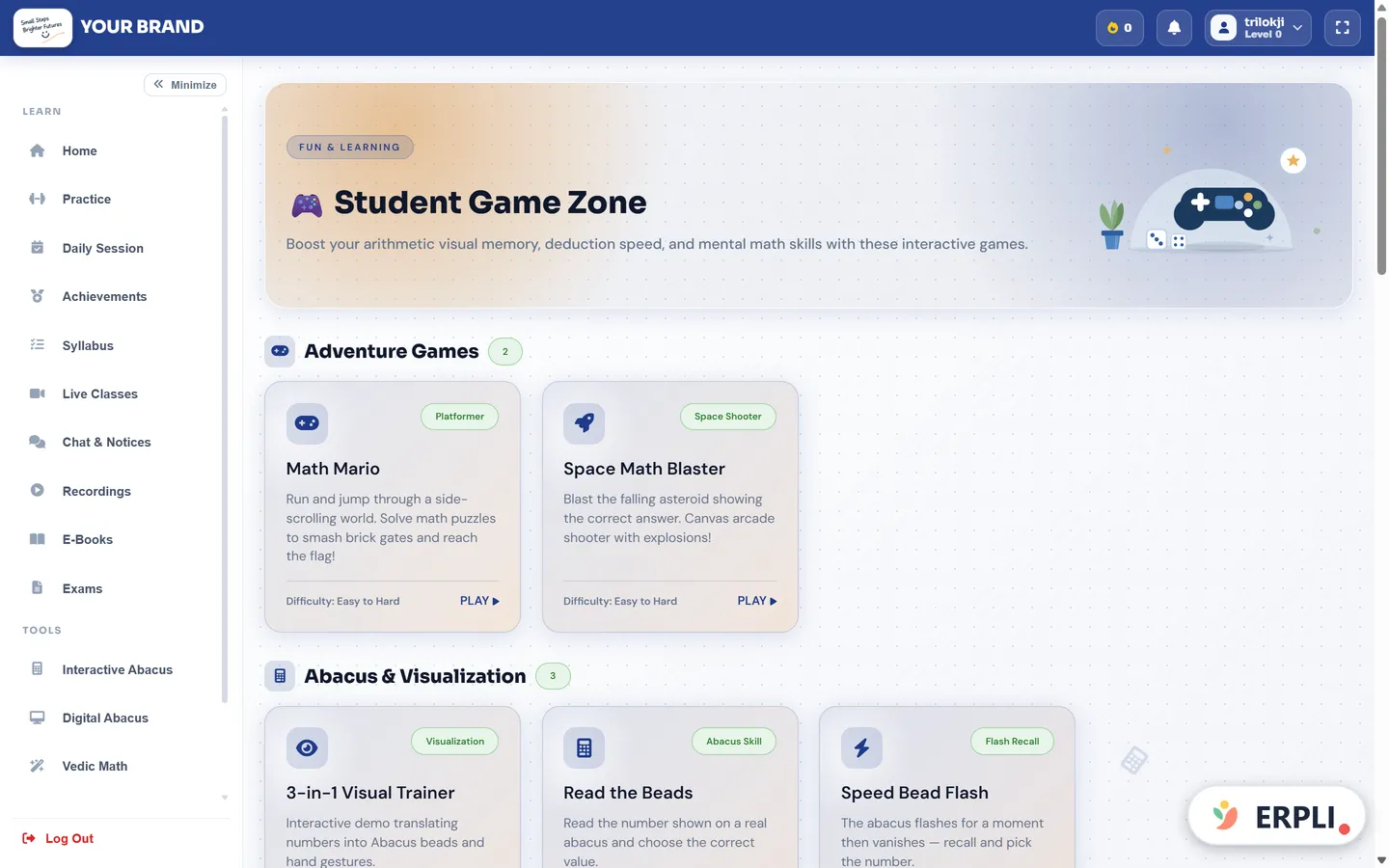
- Teachers can use ERPLI to assign level-wise flash anzan sessions and monitor results (see all features).
Integrating flash anzan into your abacus curriculum
- Add flash anzan from intermediate level onwards.
- Use it as a warm-up or cool-down in class.
- Track each student’s speed and accuracy progression.
- Offer certificates or badges for milestones to motivate learners.
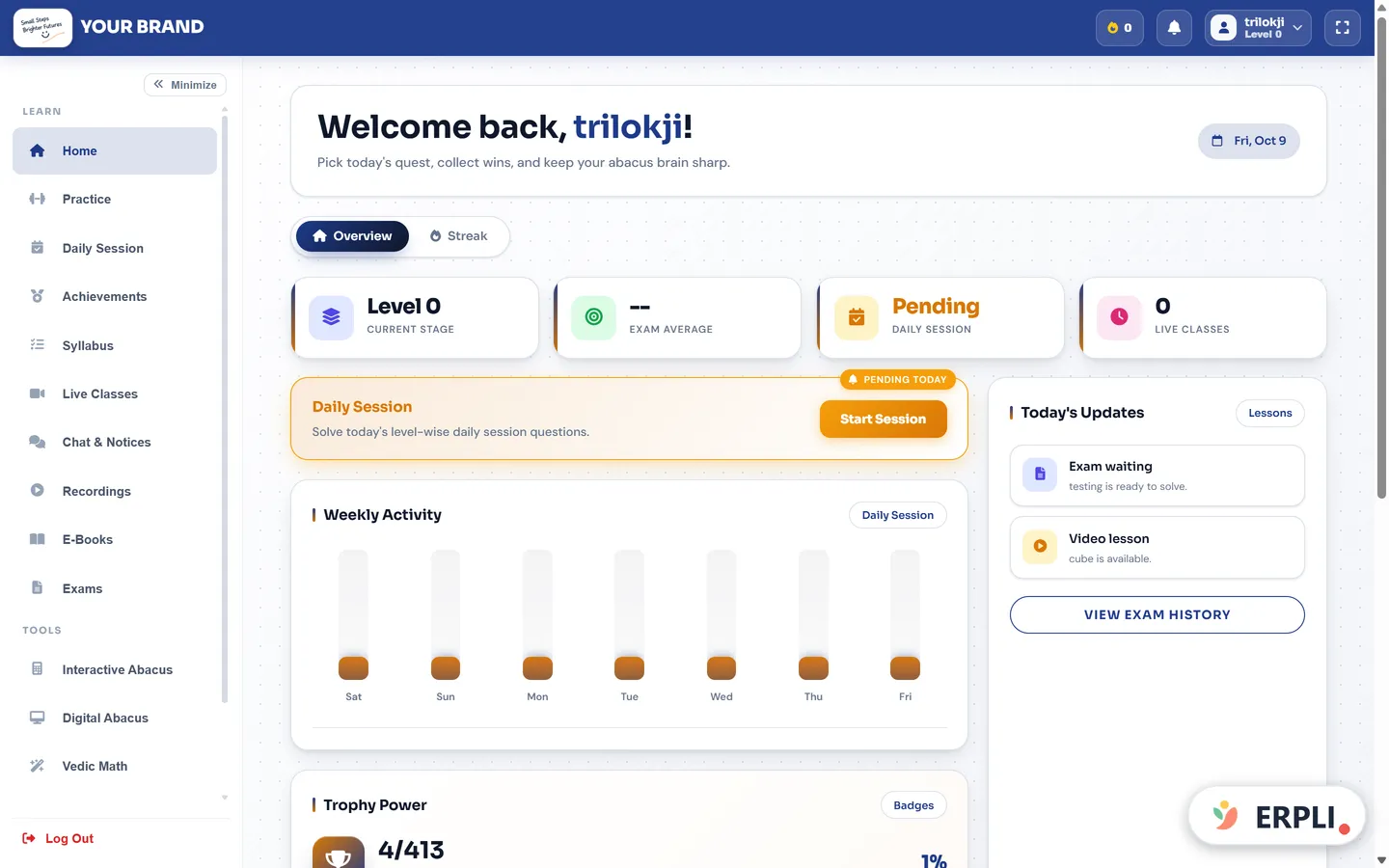
- ERPLI’s student dashboard displays progress in flash calculation and mental abacus training.
- Combine with daily practice sessions for all-round development.
Recommended tools and resources
- ERPLI’s free online abacus for interactive practice.
- ERPLI Flash Anzan practice with 53 modules and adjustable speed.
- Printable flash cards or PowerPoint for offline sessions.
- Wikipedia on mental abacus for technique background.
- Mobile apps or YouTube videos for extra drills (choose tools without ads for focus).
- For teachers, ERPLI enables batch-wise assignments, reports, and live/recorded class integration.
Tips for students and teachers to accelerate progress
- Practice daily: short, focused sessions are better than long, irregular ones.
- Encourage students to say the answer out loud immediately after the set.
- Rotate between addition, subtraction, and mixed problem sets.
- Use the “challenge mode” or competitions for motivation.
- Teachers should adjust speed based on each student’s comfort and results.
- For advanced students, mix in Vedic Maths for variety.
Next step
Mastering flash anzan takes time, patience, and the right practice tools. Whether you’re a teacher or advanced student, start with a manageable speed and build up steadily. Explore ERPLI’s flash anzan modules, track your growth, and unlock new levels of mental calculation skill.