ERPLI
Adults can learn to use an abacus. The useful question is what you want from it: understanding bead arithmetic, enjoying a new skill, checking everyday calculations or developing mental-abacus fluency. Those are different goals. Start with a small, observable task instead of expecting to match a competition video after a few lessons.
This guide is for adults starting from scratch or returning after childhood classes. It offers a four-week introduction, not a promise of mastery. You can work with a physical soroban, a compatible screen tool or a teacher who demonstrates both. Your progress should be judged by accurate independent work and clear explanations before speed.
Why adults are asking about abacus again
We searched Reddit and GitHub while preparing this guide on 9 November 2026. In an October 2026 Reddit discussion about adult mental maths, a learner asked whether soroban was worth learning and how long improvement takes. A separate discussion started in 2024 asked whether adulthood was too late. These show the question recurring over time; they are not a survey or evidence of a recent surge.
The updated answer is to match the investment to your purpose. If you want to calculate 15% of 80, ordinary arithmetic strategies may meet that need immediately: 10% is 8 and 5% is 4, giving 12. If the bead representation interests you, learning soroban can be a worthwhile project in its own right. You do not need to claim that it is the fastest route to every practical calculation.
Physical abacus and mental abacus are different milestones
On a physical soroban, you represent a number with beads and follow procedures to change that representation. Mental abacus uses an imagined representation. Being able to add on the frame does not mean you will immediately perform the same operation without seeing it. Practise the physical representation until you can describe the changes accurately, then ask a teacher about suitable mental work.
An adult learner's detailed GitHub account describes online instruction, practice logging and experimentation with input devices. It illustrates one person's learning process, not a standard adult timetable. The account also highlights a practical distinction: a teacher seeing an on-screen result may still need a camera view to check the learner's finger movements.
Choose a first goal you can actually check
Replace “become good at maths” with something you can observe. One beginner goal might be to set and read two-digit whole numbers, reset the board and complete several familiar additions without prompting. A second goal could be explaining how place value changes the meaning of a bead on adjacent rods. Your teacher can adjust the scope after seeing your starting skills.
Write down why you are learning. A hobby learner may care about enjoying a consistent routine. A parent learning alongside a child may want to understand the homework instructions. A tutor needs accurate technique and the ability to explain errors. None of these goals requires copying a child's competition target or purchasing a complete academy management system.
Your first four weeks: a suggested introduction
| Week | Main focus | What to demonstrate |
|---|---|---|
| 1 | Read the frame and establish place value | Set a number, read it back and explain the chosen units rod |
| 2 | Simple operations within taught rules | Explain the starting value and each change |
| 3 | Review difficult transitions with guidance | Correct a repeated mistake without guessing |
| 4 | Mix familiar questions and review progress | Work independently on comparable tasks |
This is an editorial practice outline, not a recognised certification syllabus. Stay on a stage longer when necessary. If you miss several sessions, review retained skills before increasing difficulty. There is no benefit in arriving at week four with a longer worksheet if the same basic representation error remains unresolved.
A worked example: reading before calculating
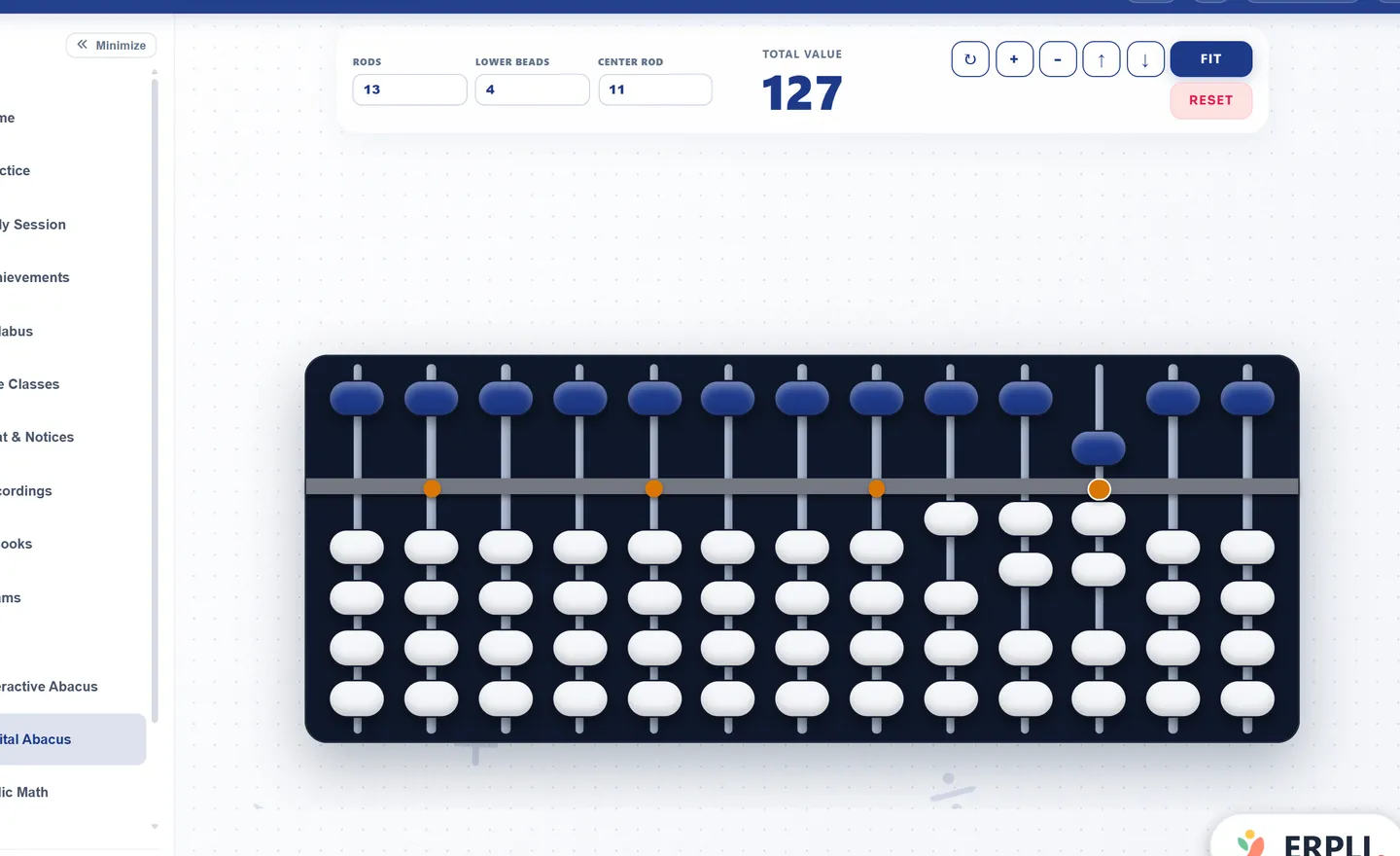
For this example, designate the rightmost rod as units and the next rod as tens. On a standard one-upper, four-lower soroban, an upper bead touching the bar counts as five units of its rod. Each lower bead touching the bar counts as one. To show 23, activate two lower beads on the tens rod and three on the units rod.
Add 1 by moving one more lower bead on the units rod to the bar. Read the result as 24. Reset and represent 42, then explain why the same two bead counts have different values when their positions change. This deliberate reading step is useful even if you already know that 23 + 1 equals 24. You are learning a representation, not merely recalling an answer.
When you reach a transition that cannot be done with the available lower beads, use the method your teacher has introduced. Do not invent movements to make the final display look right. See the small-friend formulas guide for the relevant complements, and confirm that the lesson matches your course.
How much should you practise?
Choose a short slot you can maintain. Ten minutes is a convenient starting suggestion, not an evidence-based requirement for every adult. Spend some of it reading numbers, some completing appropriate exercises and some reviewing an error. Record the task and the help you needed. A log that says “carrying confused me” is more useful than one that only records minutes.
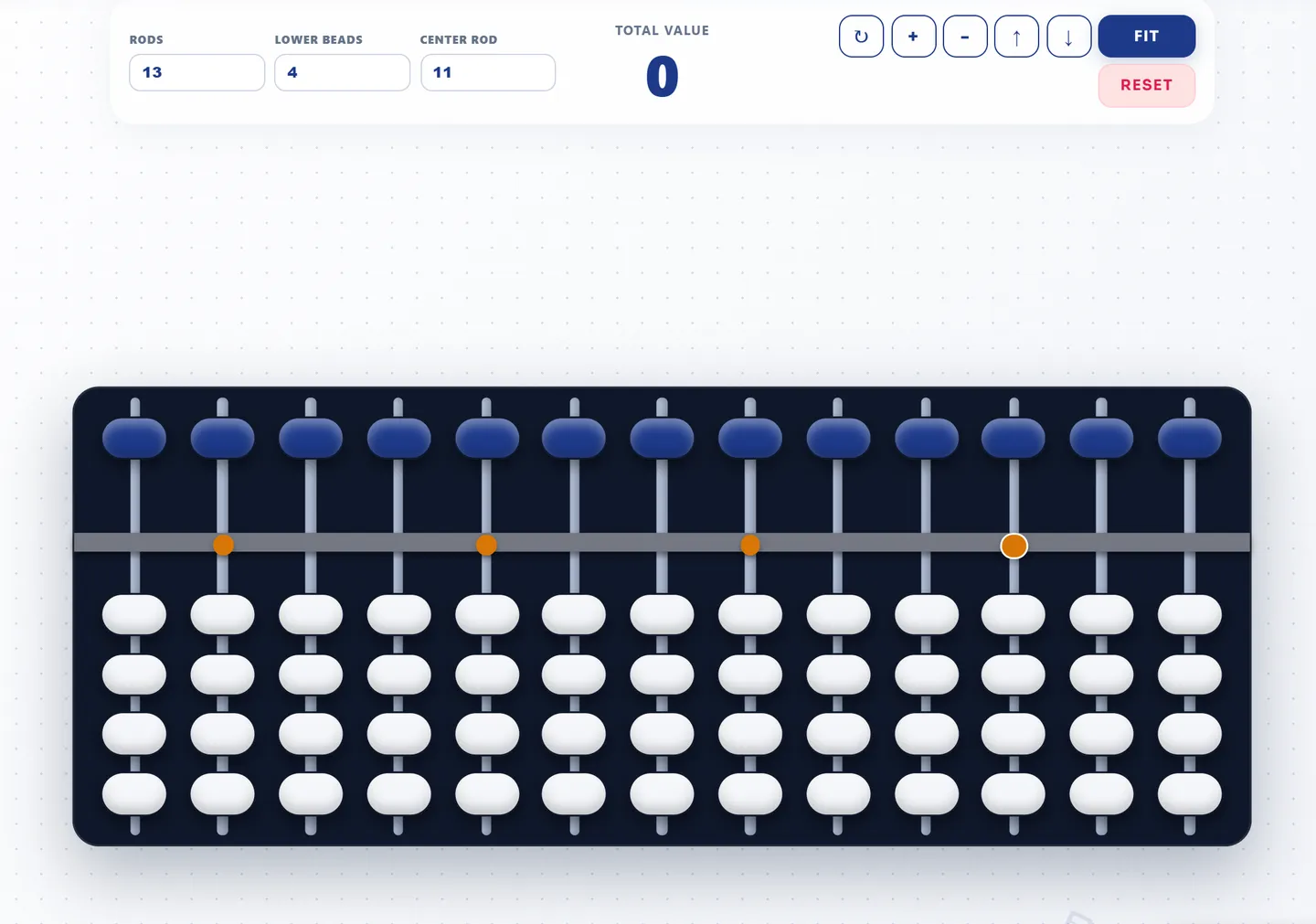
If you work on a laptop all day, a physical frame might make the routine more comfortable. If you travel, a screen tool may be easier to carry. Try the free digital abacus to explore the representation, then decide whether a physical frame or live lesson would help. Do not assume one interface works best for everyone.
How long until you notice progress?
Look for small changes: reading a displayed number with fewer pauses, resetting reliably or explaining a familiar operation without notes. Those can be reviewed after several sessions. A claim that all adults reach mental fluency in a fixed number of weeks is not justified by the community accounts we found.
If speed is your goal, first compare accuracy on similar tasks. Keep digit count, operation type and the amount of help consistent. A faster score on an easier exercise is not a meaningful improvement measure. For a course commitment, ask the provider for its actual level structure; our course-duration guide explains how to assess that schedule.
What does research actually support?
A randomised classroom study of mental-abacus instruction reported an arithmetic advantage in children after sustained instruction. It was not an adult learning trial or a test of this four-week outline. Do not use it to promise an adult a particular learning speed, a higher IQ or improved performance in every mathematical subject.
Use your own work samples for practical decisions. If bead practice is enjoyable and your chosen skill is improving, continue. If your immediate need is everyday percentages, also practise decomposition and estimation. You can learn more than one arithmetic strategy and choose the one that makes a particular calculation easiest to understand.
Questions adults ask before starting
Can I learn without a teacher?
You can explore a board and beginner demonstrations independently. A teacher is useful when you cannot explain a movement, repeatedly make the same error or want feedback on technique. Ask for a short introductory lesson rather than assuming you must buy a complete multi-year course first.
Will I get confused by my existing mental-maths method?
You may initially switch between approaches. Practise a clearly labelled task using the method being taught, then discuss alternatives separately. The aim is accurate reasoning and a deliberate choice, not banning every calculation strategy you already know.
Do I need a child's syllabus?
Ask for an adult-appropriate pace and examples. You still need the basic representation and movements, but the teacher can explain them without using activities intended for a very young class. Familiarity with written arithmetic does not automatically supply correct bead technique.
A sensible next step
Spend one session setting and reading numbers, then write down the part you found easy and the part you could not explain. Bring those observations to a teacher or use them to choose your next tutorial. Adults can begin with a modest goal and decide whether to continue after actual experience, without promising themselves a competition result.