ERPLI
Common abacus mistakes often begin with reading the frame, choosing the wrong rod or moving a bead incorrectly. Before assigning more practice, identify the first step that went wrong. A wrong final answer does not tell you whether the learner misunderstood arithmetic, forgot a rule or accidentally tapped the wrong part of a screen.
This guide helps parents and tutors review beginner whole-number work on a standard Japanese soroban with one upper bead and four lower beads per rod. Confirm your course's finger technique and notation with the teacher. Other abacus layouts and advanced methods can use different conventions, so a screenshot from another tutorial may need explanation before you copy it.
Mistake 1: counting every bead instead of active beads
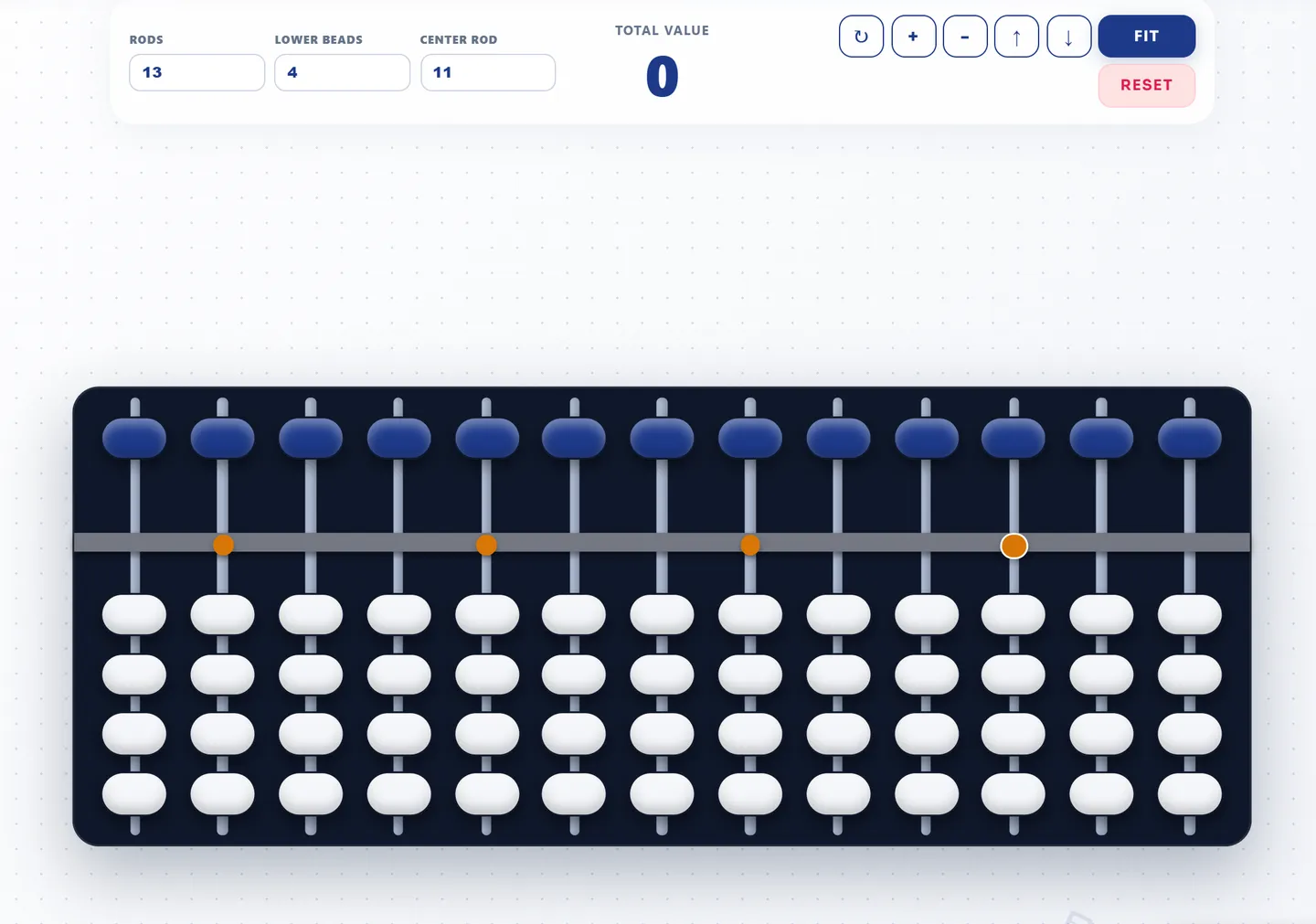
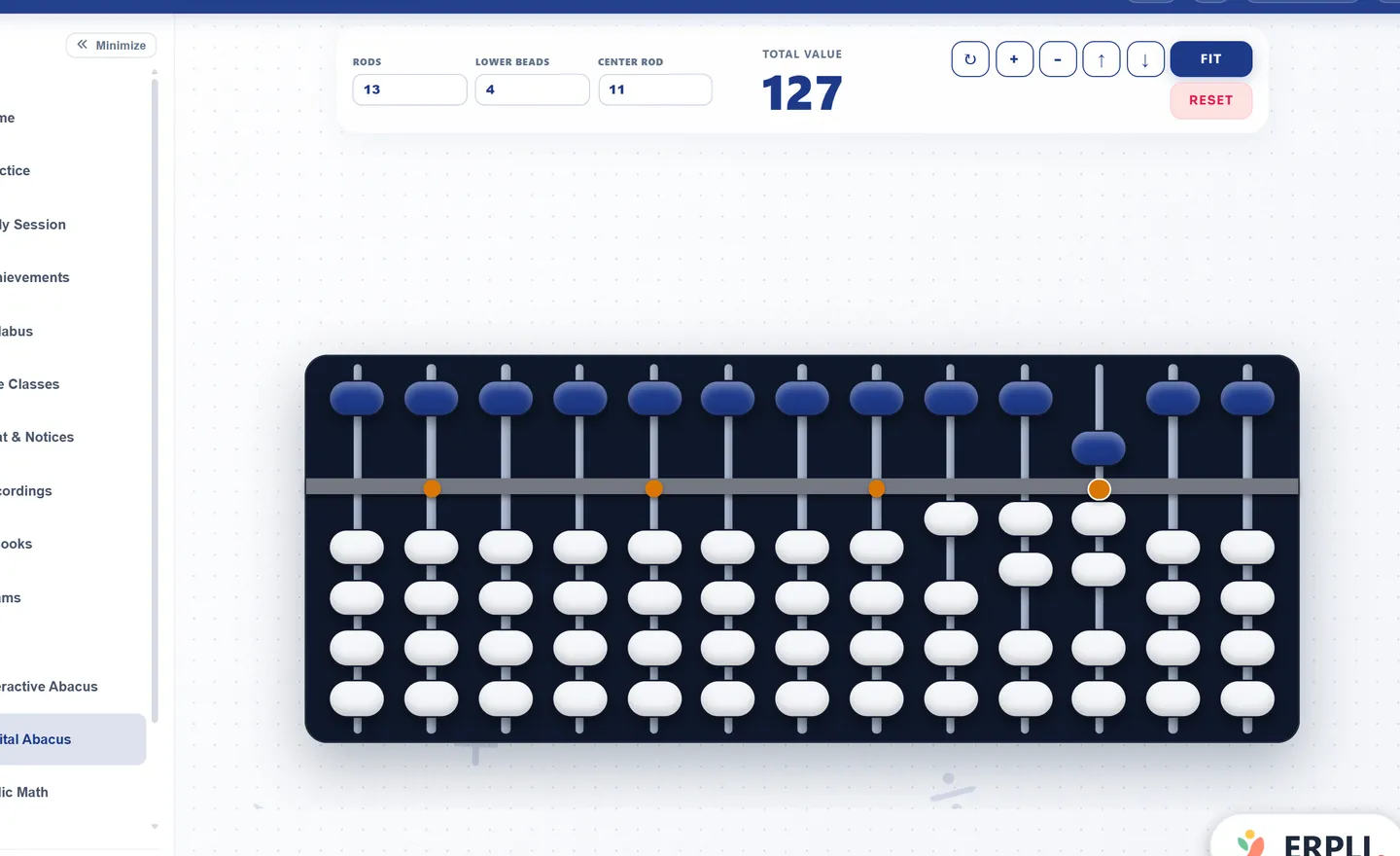
On the standard frame described here, count beads moved toward the horizontal bar. An active upper bead has a value of five units of its rod; each active lower bead has a value of one. A beginner who counts every visible bead may read the same number regardless of the board's state.
Start with one rod. Set 3 using three lower beads against the bar, then set 5 using the upper bead. Ask the child to describe which beads count and why the other beads do not. Only then show 8 as the upper bead plus three lower beads. Keep the exercise about reading; do not add a timer while the representation is still unclear.
Mistake 2: losing the units position
Designate a units rod for the exercise and explain that the rod to its left is tens. The same active bead arrangement has a different value on those two rods. A learner who moves a bead on the tens rod while intending to add one may get an answer ten larger rather than one larger.
For example, set 23. Ask the child to add 1 and explain why the result is 24. If the display becomes 33, return to the units designation rather than teaching another formula. Then set 32 and repeat a similar task. Changing the starting number checks whether the child understands the position rather than memorising one display.
Mistake 3: mixing two bead layouts
A one-upper, four-lower frame and a traditional two-upper, five-lower frame do not look identical. The Deerpfy abacus project on GitHub documents both layouts and their different bead counts. That is product documentation, not evidence that one layout is better for every learner.
For a beginner following a specific soroban lesson, use the matching layout consistently. If a video shows extra beads, explain the difference before using it as homework. Avoid calling an unfamiliar board “wrong” merely because it differs from your child's frame. The immediate issue is whether the teaching instructions and the tool correspond.
Mistake 4: guessing when direct addition runs out
On a one-upper, four-lower frame, there are only four lower beads. A learner adding to 4 cannot solve every next step by moving another lower bead. They need the relevant exchange or complement procedure taught in the course. Guessing at bead movements may accidentally produce a correct result while leaving the rule misunderstood.
An arithmetic explanation for 4 + 3 is 4 + 5 − 2 = 7. The complement relation is 3 = 5 − 2. A teacher should connect that relation to the permitted bead movements. Do not present it as adding an unexplained extra five. Use the small-friend guide for further examples at the appropriate lesson stage.
Mistake 5: crossing ten without understanding place value
When adding 3 to 8, the arithmetic can be written as 8 + 10 − 7 = 11. The tens and units representation both change. If a learner only tries to fit more value onto the units rod, stop and review what the tens rod represents. The frame is recording a change in place value, not simply accumulating a larger pile of beads.
The big-friend formulas describe complements to ten. Introduce them through a teacher's worked sequence and check each step. A child who can recite “add ten, subtract seven” should also explain why the total change is three. Saying the formula quickly is not the same as understanding its effect.
Mistake 6: carrying one answer into the next question
Some worksheets intentionally use a running total; others contain independent questions. A learner may leave the previous answer on the frame even though the next item requires a fresh starting value. Before marking several answers as arithmetic failures, check which kind of task the child thought they were doing.
For independent questions, build a simple routine: read, reset, set the starting number, operate and read back. For a running-total exercise, state that the existing value must remain. Write the instruction clearly on a worksheet or repeat it before a digital activity. A consistent start prevents a correct procedure being applied to the wrong initial state.
Mistake 7: treating touch errors as knowledge gaps
Watch the child's finger and the resulting bead position. If they identify the correct rod but a nearby bead moves, try a larger screen or a physical frame. If they intentionally choose the wrong rod, review the representation. Those situations need different responses even if the final wrong answer looks the same.
An adult learner's GitHub account discusses the extra visual checking involved in touchscreen input. It is one person's experience, not a finding that all touch tools are unsuitable. Its useful contribution is the reminder to inspect input reliability separately from calculation skill.
Mistake 8: hiding the frame too early
Mental-abacus practice is a separate learning stage. If a learner cannot reliably set or read the physical representation, asking them to imagine the same steps may make the source of an error harder to identify. Return to visible work and ask for an explanation before increasing the demand.
In a Reddit discussion about visualising abacus calculations, learners ask about resources, daily practice and switching between methods. We searched that discussion during this article's review on 9 November 2026. The experiences are anecdotal and spread across several years; they do not establish a universal point at which every child should stop using the frame.
A three-question correction conversation
Ask the learner: what number did you start with, what change did the question request and what did the frame show after the first movement? Let them replay the attempt slowly. Record the first mismatch instead of only the final answer. Then demonstrate one correction and give a comparable new question to check understanding.
For an illustrative case, suppose 23 + 1 produced 33. The learner correctly states the start and operation but points to a tens bead. The next task should involve distinguishing units and tens. If they point to the correct units bead but a touch moved the neighbouring rod, adjust the interface. Neither case requires a harder addition worksheet immediately.
Keep an error log small enough to use
| Observation | Likely next check | Useful follow-up |
|---|---|---|
| Reads inactive beads | Meaning of the bar | Set and read single digits |
| Adds on the wrong rod | Units designation | Contrast 23 and 32 |
| Stalls at 4 + 3 | Complement-to-five lesson | Explain 3 as 5 − 2 |
| Wrong value after a new item | Reset instructions | Separate independent and running-total tasks |
| Correct intent, wrong on-screen move | Input reliability | Larger targets or physical frame |
These are teaching checks, not a diagnosis. More than one issue can appear in a session. Choose the earliest unresolved step, correct it and review a small amount of comparable work. Use practice records alongside the explanation rather than replacing the explanation with a score.
How to tell whether a correction worked
Return to the same principle with different numbers and without leading prompts. Ask for the reason for the movement. A correct answer immediately after copying a demonstration is encouraging, but independent work on a comparable task is a better basis for the next lesson.
Tell the teacher exactly what improved and what still needs help. “Reads units correctly but confuses the tens rod after a reset” is actionable. “Bad at abacus” is not. Beginner errors are easier to address when the response is specific, calm and connected to the representation the child is learning.