ERPLI
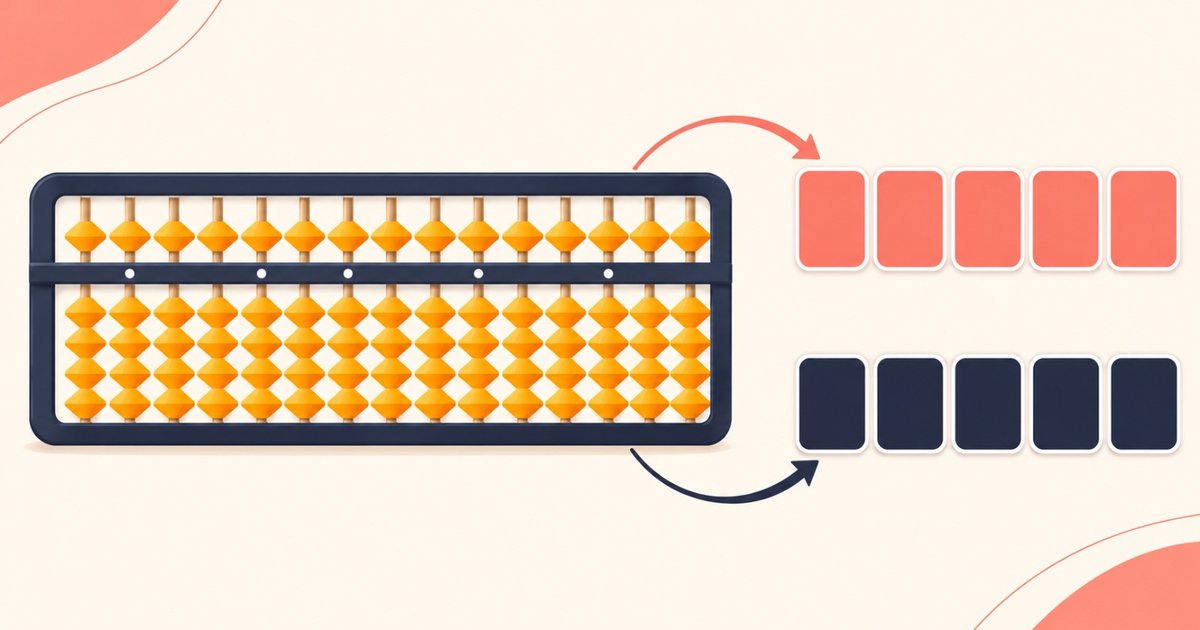
Short answer: Abacus formulas are shortcuts for when a rod doesn't have enough beads. Small friends make 5, big friends make 10, and mixed formulas use both.
This page has all 34 formulas, an example for each, the mistakes students make most, and 40 practice sums with answers. Every example has been checked bead by bead. Keep the free online abacus open in another tab and try them.
When do you need a formula?
Only when the move can't be done directly.
- 2 + 2: push up 2 more beads. No formula needed.
- 3 + 2: only 1 bottom bead is left. Use a formula: +5 −3.
Small friends (pairs that make 5)
The pairs are 1 and 4, and 2 and 3.
To add: push the top bead (5) down, then take away the small friend. To take away: push the top bead up, then add the small friend.
| Formula | Rule | Try this | What your hands do |
|---|---|---|---|
| +1 | +5 −4 | 4 + 1 = 5 | Top bead down, 4 bottom beads away |
| +2 | +5 −3 | 3 + 2 = 5 | Top bead down, 3 bottom beads away |
| +3 | +5 −2 | 4 + 3 = 7 | Top bead down, 2 bottom beads away |
| +4 | +5 −1 | 3 + 4 = 7 | Top bead down, 1 bottom bead away |
| −1 | −5 +4 | 5 − 1 = 4 | Top bead up, 4 bottom beads up |
| −2 | −5 +3 | 5 − 2 = 3 | Top bead up, 3 bottom beads up |
| −3 | −5 +2 | 6 − 3 = 3 | Top bead up, 2 bottom beads up |
| −4 | −5 +1 | 7 − 4 = 3 | Top bead up, 1 bottom bead up |
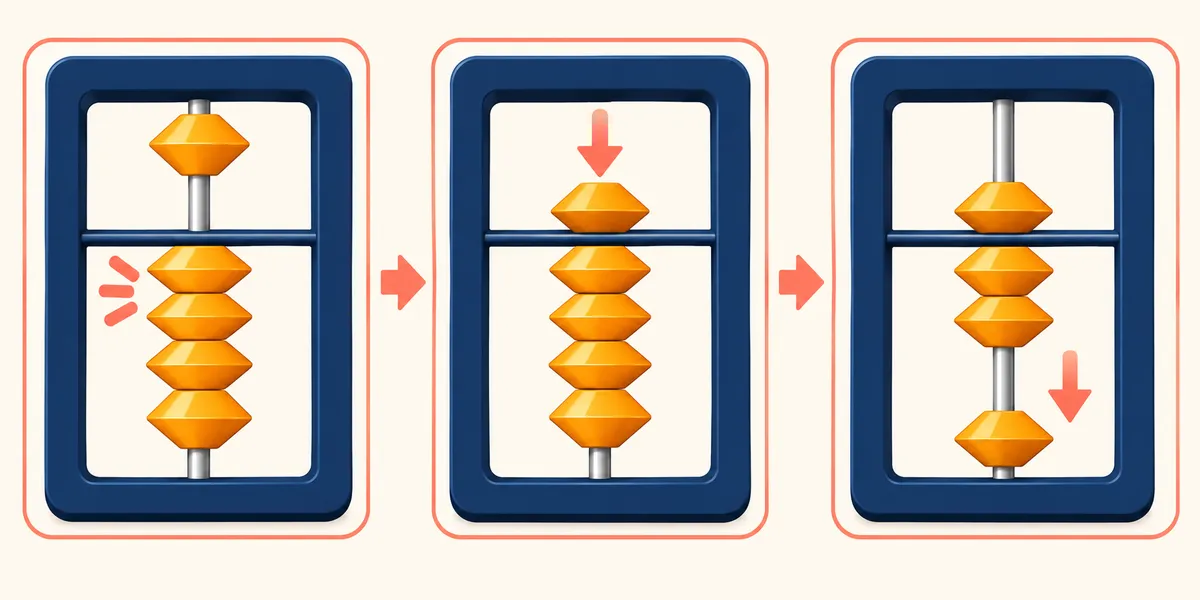
Common mistakes: taking away the wrong number of bottom beads (a child doing +4 removes 4 instead of 1), and using a small friend when a direct move was possible.
Big friends for plus (pairs that make 10)
The pairs are 1 and 9, 2 and 8, 3 and 7, 4 and 6, 5 and 5.
To add: take away the big friend on this rod, then add 1 to the rod on the left.
| Formula | Rule | Try this | Answer |
|---|---|---|---|
| +1 | −9 +10 | 9 + 1 | 10 |
| +2 | −8 +10 | 9 + 2 | 11 |
| +3 | −7 +10 | 8 + 3 | 11 |
| +4 | −6 +10 | 7 + 4 | 11 |
| +5 | −5 +10 | 5 + 5 | 10 |
| +6 | −4 +10 | 9 + 6 | 15 |
| +7 | −3 +10 | 8 + 7 | 15 |
| +8 | −2 +10 | 4 + 8 | 12 |
| +9 | −1 +10 | 3 + 9 | 12 |
Common mistakes: forgetting to add 1 to the next rod, and adding to the wrong rod (the one on the right instead of the left).
Big friends for minus
To take away: take 1 from the rod on the left, then add the big friend on this rod.
| Formula | Rule | Try this | Answer |
|---|---|---|---|
| −1 | +9 −10 | 10 − 1 | 9 |
| −2 | +8 −10 | 11 − 2 | 9 |
| −3 | +7 −10 | 11 − 3 | 8 |
| −4 | +6 −10 | 10 − 4 | 6 |
| −5 | +5 −10 | 10 − 5 | 5 |
| −6 | +4 −10 | 10 − 6 | 4 |
| −7 | +3 −10 | 11 − 7 | 4 |
| −8 | +2 −10 | 11 − 8 | 3 |
| −9 | +1 −10 | 12 − 9 | 3 |
Common mistake: adding the number itself instead of its big friend (for −3, adding 3 instead of 7).
Mixed formulas (big friend + small friend)
Sometimes the big-friend move needs a small friend too. That happens when the top bead is down and the bottom beads can't make the change.
| Formula | Rule | Try this | Why it's mixed |
|---|---|---|---|
| +6 | +1 −5 +10 | 5 + 6 = 11 | Can't take 4 from 5, so −4 becomes −5 +1 |
| +7 | +2 −5 +10 | 5 + 7 = 12 | −3 from 5 becomes −5 +2 |
| +8 | +3 −5 +10 | 5 + 8 = 13 | −2 from 5 becomes −5 +3 |
| +9 | +4 −5 +10 | 5 + 9 = 14 | −1 from 5 becomes −5 +4 |
| −6 | −10 +5 −1 | 11 − 6 = 5 | Can't add 4 to 1, so +4 becomes +5 −1 |
| −7 | −10 +5 −2 | 12 − 7 = 5 | +3 on 2 becomes +5 −2 |
| −8 | −10 +5 −3 | 13 − 8 = 5 | +2 on 3 becomes +5 −3 |
| −9 | −10 +5 −4 | 14 − 9 = 5 | +1 on 4 becomes +5 −4 |
Common mistake: doing the big-friend carry but skipping the small-friend step on the units rod. The child ends up 5 out.
What order should formulas be learned in?
- Direct sums (no formula)
- Small friends, plus and minus
- Big friends, plus
- Big friends, minus
- Mixed formulas
Classes call these Level 1, 2 or 3 differently. The order matters more than the name.
Practice sums with answers
Each set uses only that type of formula. Try them on the abacus, then check.
Small friends (10 sums): 4 + 1 = 5 · 3 + 3 = 6 · 2 + 4 = 6 · 4 + 4 = 8 · 3 + 2 = 5 · 6 − 2 = 4 · 5 − 3 = 2 · 7 − 4 = 3 · 8 − 4 = 4 · 5 − 4 = 1
Big friends, plus (10 sums): 9 + 1 = 10 · 8 + 4 = 12 · 7 + 5 = 12 · 9 + 3 = 12 · 8 + 9 = 17 · 7 + 8 = 15 · 4 + 7 = 11 · 3 + 8 = 11 · 2 + 9 = 11 · 9 + 5 = 14
Big friends, minus (10 sums): 10 − 1 = 9 · 11 − 3 = 8 · 12 − 5 = 7 · 13 − 4 = 9 · 11 − 9 = 2 · 12 − 8 = 4 · 10 − 7 = 3 · 13 − 5 = 8 · 10 − 9 = 1 · 10 − 2 = 8
Mixed (10 sums): 5 + 6 = 11 · 6 + 6 = 12 · 7 + 7 = 14 · 5 + 9 = 14 · 6 + 8 = 14 · 5 + 7 = 12 · 11 − 6 = 5 · 12 − 6 = 6 · 13 − 8 = 5 · 14 − 9 = 5
How to practise one formula
- Set the starting number.
- Say the rule out loud: "plus 4 is plus 5, minus 1".
- Move the beads in that order.
- Check the total. Reset. Repeat with new numbers.

New to the digital abacus? Start with what is a digital abacus. Teachers can see how to teach these live in how to teach abacus online.
In ERPLI, institutes can set practice and exams by formula type, so you can see exactly which rule each child is stuck on.
About the author: Kamal Singh Aswal has spent the past year working in the abacus industry with institute founders, school founders and established abacus brands, including Oral Edutech Private Limited, the Madhya Pradesh company behind the Foreign Abacus brand. His work focuses on how institutes use the digital abacus in classes, homework and exams.