ERPLI
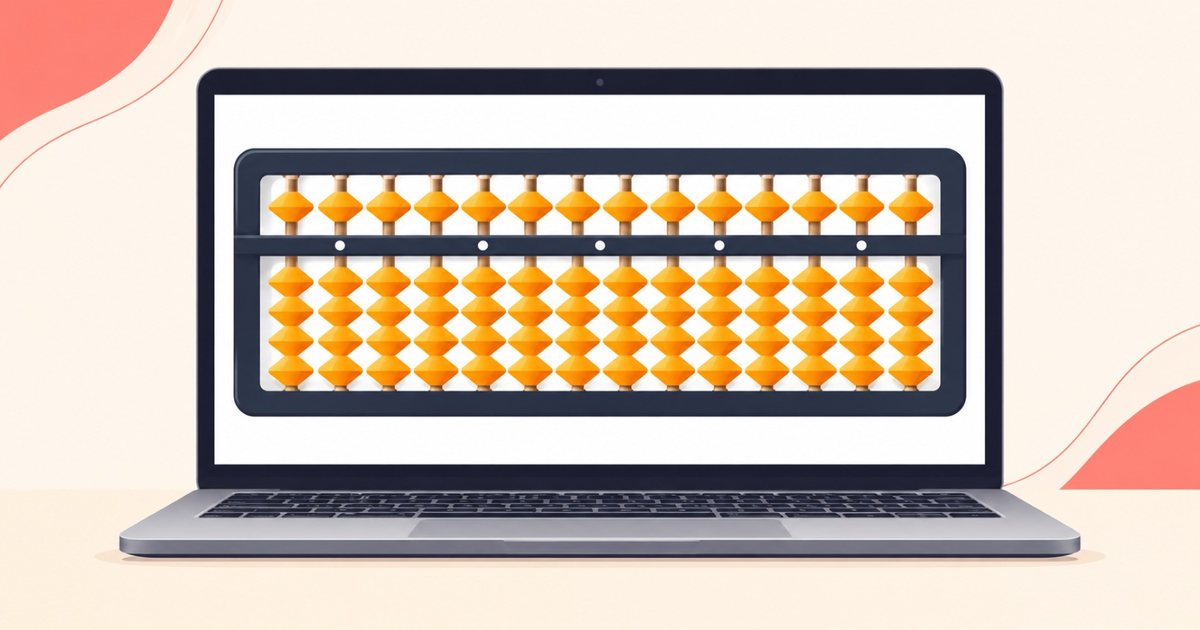
Short answer: A digital abacus is an abacus on a screen. You move the beads with a finger or a mouse, and it follows the same rules as a real Japanese soroban.
You will also hear it called a virtual abacus, an online abacus or an abacus simulator. They all mean the same thing.
This guide explains what a digital abacus is made of, how to read a number on it, where the design comes from, and what research says about learning maths on an abacus.
What are the parts of a digital abacus?
A digital abacus has the same parts as a wooden soroban. Only the material changes.
| Part | What it is | What it does |
|---|---|---|
| Frame | The border around everything | Holds the rods |
| Rods | Vertical lines | Each rod is one place value |
| Bar (also called beam) | The line across the middle | Beads count only when they touch it |
| Upper bead (heaven bead) | 1 bead above the bar | Worth 5 |
| Lower beads (earth beads) | 4 beads below the bar | Worth 1 each |
| Unit dots | Small dots on the bar, every 3 rods | Help the eye find units, thousands, millions |
Most digital versions add a few things on top: a total that shows the number on the beads, a reset button, and a way to change the number of rods.
How do you read a number on a digital abacus?
Start from the right. The rod on the far right is units, the next one is tens, then hundreds, and so on.
On each rod, add up only the beads touching the bar:
- top bead down = 5
- each bottom bead up = 1
- nothing touching = 0
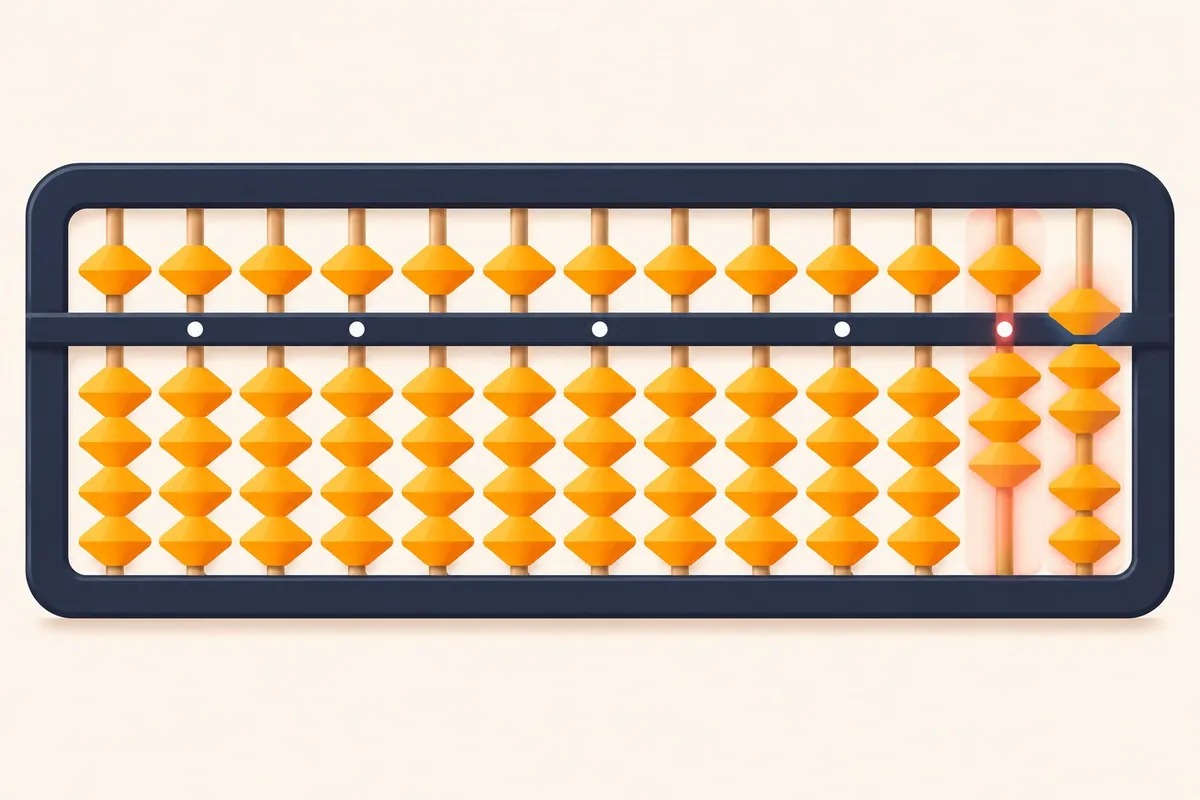
Example: 47. Tens rod: 4 bottom beads up (40). Units rod: top bead down and 2 bottom beads up (7). Total: 47.
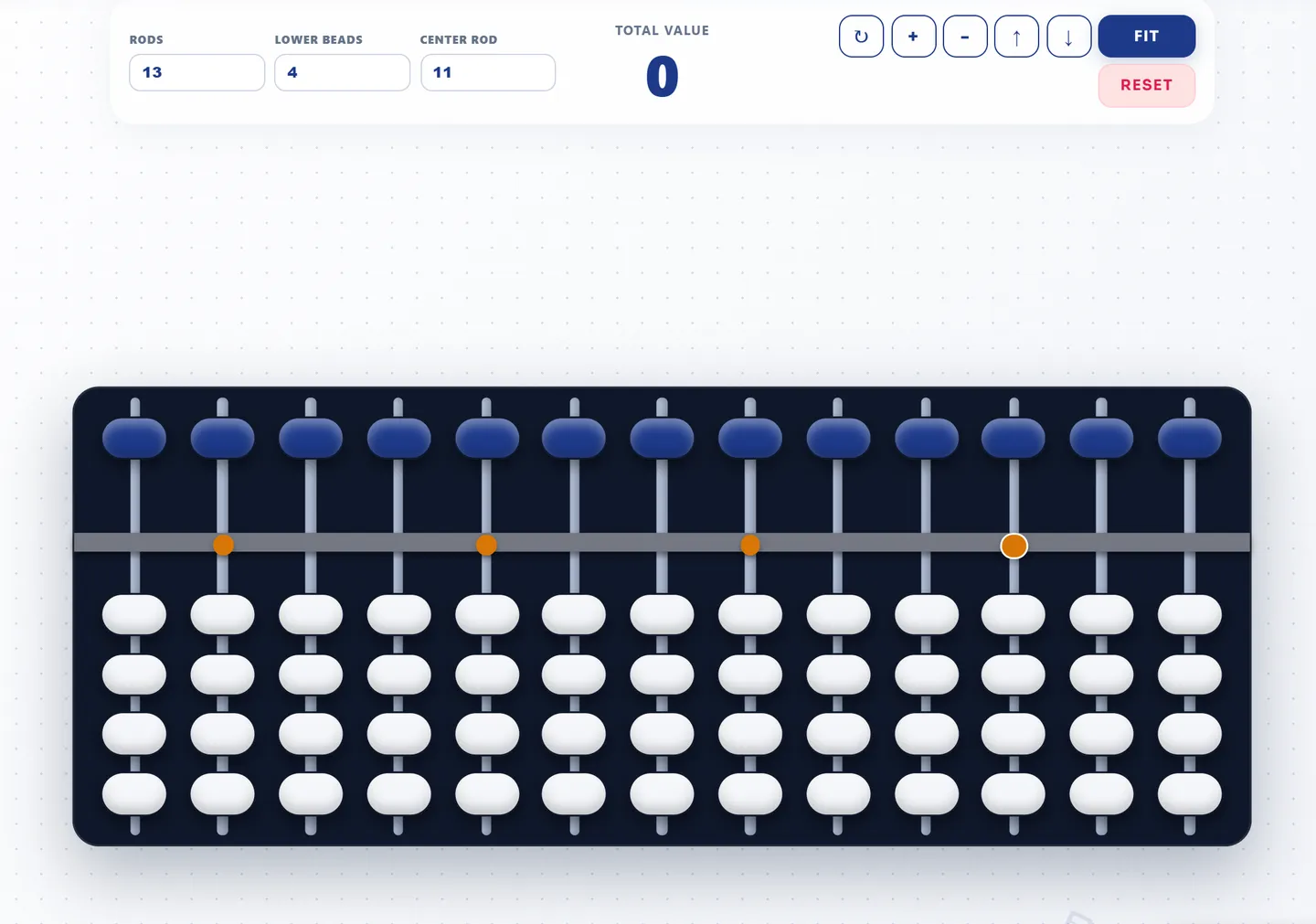
Example: 127. Hundreds rod: 1 bottom bead up. Tens rod: 2 bottom beads up. Units rod: top bead down and 2 bottom beads up. The screenshot below shows exactly this on a 13-rod abacus.
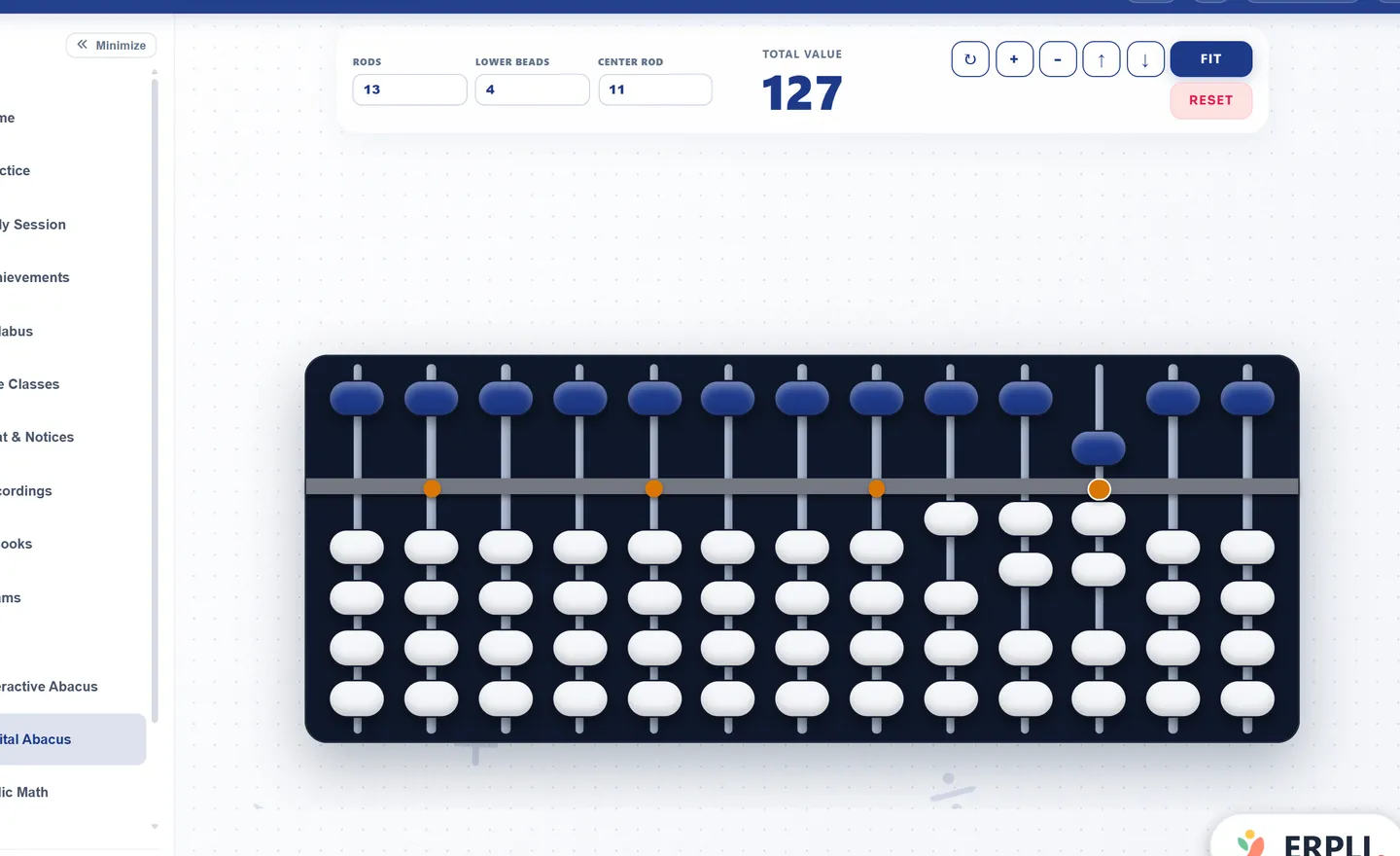
Try both numbers on our free online abacus.
Where does the digital abacus design come from?
From the soroban, the Japanese abacus. It has 1 upper bead and 4 lower beads on each rod (Wikipedia: Soroban).
The older Chinese suanpan has 2 upper beads and 5 lower beads per rod (Wikipedia: Suanpan). The extra beads allow some older calculation methods, but they are not needed for normal arithmetic.
| Soroban (Japanese) | Suanpan (Chinese) | |
|---|---|---|
| Upper beads per rod | 1 | 2 |
| Lower beads per rod | 4 | 5 |
| Highest value on one rod | 9 | 15 |
| Used in most Indian abacus classes | Yes | No |
So when an Indian institute says "abacus", it nearly always means a soroban. A good digital abacus should copy the soroban exactly.
What does research say about abacus and mental maths?
Mental abacus means doing sums by picturing the abacus in your head. Two well-known studies looked at how it works.
Children picture the beads, not the words. Michael Frank and David Barner studied skilled mental-abacus users and found the method relies on visual memory, not on saying numbers in your head (Frank & Barner, 2012). Users seemed limited by how many rods (columns) they could picture, not by how many beads were on each rod.
It works in normal classrooms, but not equally for everyone. A 3-year randomised trial with children aged 5 to 7 in Indian classrooms found many children could learn mental abacus in a normal school setting. The benefits were smaller for children with weaker spatial working memory (Barner et al., 2016).
What this means for a digital abacus:
- Children must look at the beads. The method works because the bead picture builds up in memory. If a child only reads the total on screen, that picture never forms.
- Fewer rods first. Since the limit is how many rods a child can picture, start beginners with 5 or 7 rods and add more slowly.
- Some children need more time. Expect a spread in progress, and plan extra practice for slower children instead of pushing everyone at one speed.
What does a digital abacus add that a wooden one can't?
- A total on screen. Good for learning, but hide it during practice and tests.
- Any number of rods. 5 rods for a beginner, 17 for long division, in one tap.
- Always with you. On any phone or laptop, so practice doesn't depend on carrying a frame.
- Easy to share. On a video call or smartboard, every child sees the same beads.
What it can't add is finger technique. The thumb and index finger still learn best on a real frame. When to use which is covered in digital abacus vs physical abacus.
What kinds of digital abacus are there?
| Kind | How you use it | Typical use |
|---|---|---|
| Website | Open a link | Teacher demos, quick practice |
| Phone app | Install it | Practice at home |
| Inside class software | Part of an institute's platform | Homework and exams on the beads |
| Electronic frame | A physical device with a display | Classrooms without screens |
If you want to compare real tools, we tested several free ones in best digital abacus for abacus institutes, including a 2-minute checklist you can run on any tool.
Where to go next
- Learn the bead rules: abacus formulas, small friends and big friends.
- Teaching online: how to teach abacus online.
In ERPLI, institutes use this same abacus for live classes, homework and level exams, so a teacher sees each child's beads and not just the final answer.
About the author: Kamal Singh Aswal has spent the past year working in the abacus industry with institute founders, school founders and established abacus brands, including Oral Edutech Private Limited, the Madhya Pradesh company behind the Foreign Abacus brand. His work focuses on how institutes use the digital abacus in classes, homework and exams.